From Poetry to Prose: Why Romance Sells Across Generations
Romance evolves with every generation—changing its voice, not its heart. From poetry to prose, love stories remain timeless and deeply human.on Feb 17, 2026
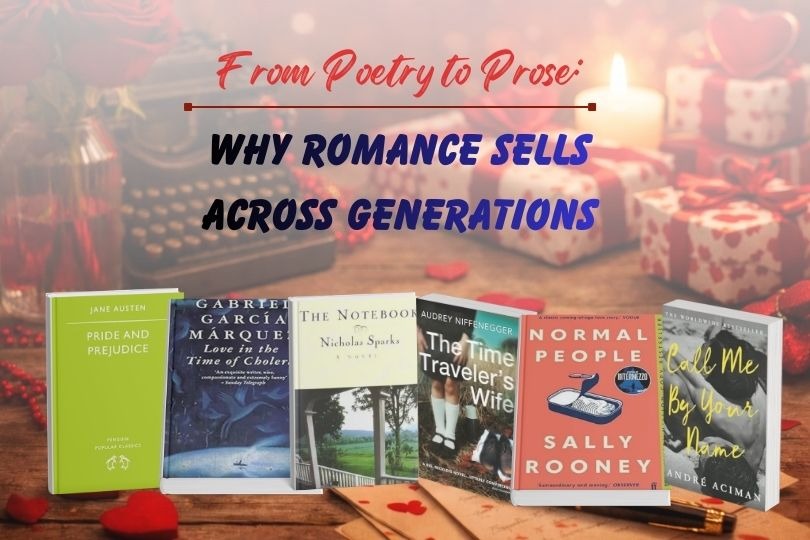
Romance has never belonged to just one age group, one format, or one shelf in a bookstore. It has moved effortlessly from handwritten poetry to mass-market paperbacks, from quiet longing to loud declarations, from epistolary love to WhatsApp confessions. And yet, across generations, cultures, and publishing trends, romance books across generations continue to sell—consistently and unapologetically.
The reason is simple: romance doesn’t age, people do. And every generation finds its own language to say the same thing—we want to be seen, chosen, remembered.
When Romance Was Poetry
Long before romance became a genre, it existed as verse. Poetry was the earliest form of romantic storytelling—compressed, emotional, and intimate. Love poems weren’t written for markets or trends; they were written to survive distance, longing, and silence.
Older generations grew up reading romance that was suggestive rather than explicit. Desire was coded. Love was restrained. A glance mattered. A pause mattered more. These stories didn’t rush toward endings; they lingered in feeling.
Romance, at this stage, was less about plot and more about emotional resonance—and that foundation still holds.
The Shift to Prose and Plot
As reading habits expanded and publishing became more commercial, romance found a new home in prose. Novels allowed writers to stretch emotions across chapters, conflicts, and time. Love stories now came with obstacles—class, family, war, geography, morality.
This shift made romance books across generations feel more relatable on a mass scale. Readers didn’t just witness love; they lived inside it. Prose gave romance room to breathe, to complicate itself, to fail and try again.
For Gen X and early millennials, romance novels often reflected stability and struggle—marriage, responsibility, societal expectations. Love wasn’t just a feeling; it was a decision.
Modern Romance and Emotional Realism
Today’s romance is emotionally louder, more self-aware, and unapologetically diverse. Younger readers gravitate toward stories that acknowledge mental health, identity, consent, ambition, and imperfection. Love is no longer idealized as flawless—it’s shown as messy, healing, unfinished.
What hasn’t changed is the core appeal. Romance still promises emotional payoff. In a fragmented digital world, it offers continuity. In a chaotic reality, it offers control. You may not know how the world ends, but in a romance novel, emotions are acknowledged—and that certainty sells.
Why Romance Never Stops Selling
Romance adapts because readers change—but feelings don’t.
Every generation falls in love for the first time.
Every generation experiences heartbreak.
Every generation looks for stories that reassure them that connection is possible.
Romance doesn’t compete with trends; it absorbs them. It can be literary or commercial, poetic or blunt, tragic or comforting. It survives because it evolves without losing its emotional core.
From poetry whispered in margins to prose devoured on Kindles, romance books across generations continue to prove one thing: as long as people feel deeply, love stories will always have readers.
Romance Books Across Generations
Pride and Prejudice – Jane Austen
Publisher: Penguin Classics
A foundational romance where wit, social observation, and emotional restraint define love.
Love in the Time of Cholera – Gabriel García Márquez
Publisher: Penguin India
A meditation on enduring love, time, obsession, and patience.
The Time Traveler’s Wife – Audrey Niffenegger
Publisher: Vintage
Romance shaped by fate, loss, and non-linear time.
The Notebook – Nicholas Sparks
Publisher: Grand Central Publishing
A modern classic built on devotion, memory, and emotional endurance.
Call Me by Your Name – André Aciman
Publisher: Atlantic Books
A lyrical, introspective coming-of-age romance rooted in desire and memory.
Normal People – Sally Rooney
Publisher: Faber & Faber
Contemporary romance that explores intimacy, miscommunication, and emotional class divides.
Post a comment
0 comments

Trending Posts
.jpg)
.jpg)


.jpeg)

.jpg)

Recent Post
.jpg)
.jpg)



Related Post
.jpg)
.jpg)
.jpg)

 (1).jpg)
.jpg)

© 2026 - Frontlist - News and Updates of Publishing Industry, Book Reviews, Education News, Author Interviews, and Videos.. All Rights Reserved.
Sorry! No comment found for this post.