Interview with Malvika Bahl, Author of You're Second To None, Andy!
In this author interview, Malvika discusses You’re SECOND TO NONE! Andy, explaining how the story introduces children to the Bhagavad Gita’s wisdom on effort, self-worth, resilience, and handling success and failure. She also shares her vision for MAADHEVA Books and the importance of nurturing emotional balance from childhood.on Nov 18, 2026
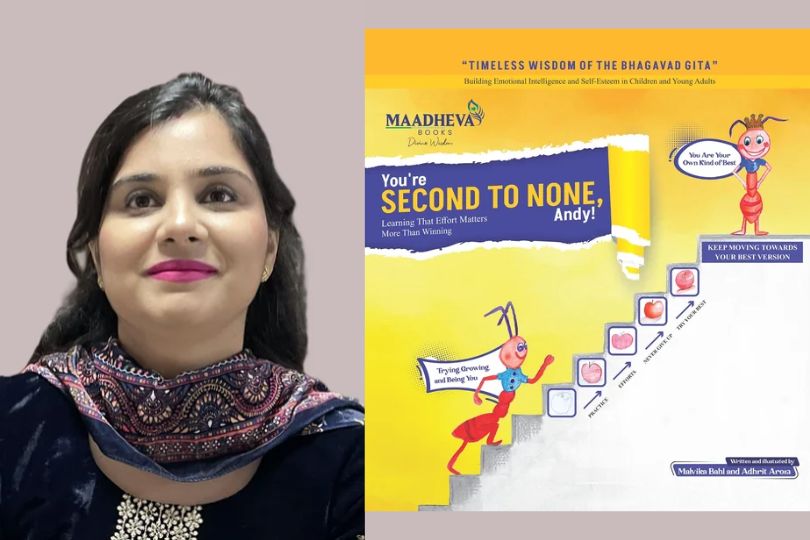
Frontlist: From engineering to picture books : You are an M.Tech, an Assistant Professor, and have published technical papers with IEEE and Elsevier. What led you to write and illustrate books for children?
Malvika: As an M.Tech-qualified Assistant Professor at an engineering college, I spent years teaching young adults and witnessed many of them struggle with stress, anxiety, and uncertainty about their future. It led me to a profound question: What if we nurtured a child’s inner world as consciously as we nurture their intellect?
Motherhood transformed this question into my life’s purpose. I came to believe that the formative years of childhood and adolescence offer a precious opportunity to cultivate self-worth, emotional intelligence, resilience, and inner balance—before comparison, fear of failure, and the pursuit of external validation begin to define a child’s sense of worth.
This belief became the inspiration behind MAADHEVA Books.
Our vision is to bring the timeless wisdom of the Bhagavad Gita to children through thoughtfully crafted, pedagogically designed picture books. Because true education is not only about preparing children for the world, but also about helping them discover the wisdom within themselves.
Frontlist: Why Andy? Can you tell us about Andy’s character and the story behind him? Was he inspired by a real child, perhaps your own, or by children you have taught?
Malvika: Andy represents every child who gives their whole heart to what they do, believing that sincere effort should always be rewarded. Through Andy’s journey, children discover a deeper wisdom: effort is in our hands, but rewards are not always in our control. True growth lies in learning to give our best, embrace every outcome, and remain confident in our own worth—whether we win or lose.
Frontlist: “Second to None”: The title reframes the idea of being “second.” What do you want a child to feel when they hear “You are second to none,” and how is that different from “you are the best”?
Malvika: When a child hears “You are SECOND TO NONE,” I want them to feel that they are unique, worthy, and incomparable—not because they have defeated someone else, but because their worth was never dependent on being better than others.
“You are the best” can unintentionally place a child in a race for superiority, where self-worth becomes tied to winning, rankings, and recognition. “You are SECOND TO NONE” offers a deeper perspective: you do not need to be first to be extraordinary, nor do you need to outperform anyone to be worthy.
Through Andy, I want children to understand that wholehearted effort, sincerity, and the courage to keep going matter more than the rewards they receive. Sometimes hard work brings success; sometimes it brings lessons, growth, and resilience. Both have value.
Being second to none is not about standing above others. It is about standing secure within yourself.
Frontlist: Effort over winning: Today’s children face constant comparison, from exam ranks to social media. How did you approach teaching that effort matters more than winning without making it sound like a lecture?
Malvika: I believe children learn wisdom best when they experience it through stories rather than receive it as a lecture. Through Andy, I wanted to create a space where children could see their own hopes, expectations, disappointments, and triumphs reflected in a character they could relate to.
Rather than telling children not to compare themselves with others, I wanted them to discover that their real growth lies in showing up, trying sincerely, learning from setbacks, and finding the courage to begin again. The story allows this understanding to unfold naturally, through Andy’s experiences, rather than through moralising or preaching.
In a world that constantly measures children through ranks, awards, and achievements, my hope is that Andy reminds them that winning is an outcome, but wholehearted effort is a choice. Their worth remains unchanged by either success or failure.
Frontlist: The Bhagavad Gita for young readers: The book draws on Chapter 2, Verse 47. How do you explain the idea of focusing on action and not on results to a young child, and what did you leave out to keep it age-appropriate?
Malvika: For a young child, I believe the wisdom of the Bhagavad Gita must first be felt through everyday experiences before it can be understood as philosophy. Chapter 2, Verse 47 teaches us to focus on our actions rather than become attached to their results. I wanted to translate this profound wisdom into a simple, relatable lesson through Andy’s journey.
Children naturally believe that if they work hard, practise sincerely, or give something their very best, they should always be rewarded with success, appreciation, or a prize. Andy represents this very expectation. Through his experiences, I wanted children to begin discovering that we can give our best to our efforts, but we cannot always decide the outcome.
For instance, a child may prepare wholeheartedly for an examination or practise diligently for a competition and still not achieve the result they hoped for. Rather than viewing this as a failure of their worth, they can learn to value what the experience has taught them and find the courage to continue trying.
To keep the teaching age-appropriate, I deliberately moved away from complex philosophical explanations, abstract spiritual terminology, and discussions of duty, renunciation, or detachment in their deeper theological sense. Instead, I focused on the emotional experiences children already understand: wanting to win, feeling disappointed, comparing themselves with others, and learning to try again.
My intention was not to teach children that results do not matter, or that they should stop aspiring to succeed. It was to help them develop a healthier relationship with success and failure, where ambition can coexist with inner peace.
Frontlist: Exam stress and performance anxiety: The book is pitched as a read before any exam, match, or audition. What practical tools or habits can a child take from it on the day of a big challenge?
Malvika: I want You’re SECOND TO NONE! Andy to be a gentle reminder for children before they step into an examination hall, onto a sports field, or onto an audition stage. The idea is not to promise them success, but to help them approach every challenge with a calmer mind and a healthier perspective.
Andy represents the child who puts his whole heart into an endeavour and expects his hard work to ALWAYS be rewarded. This is a very natural expectation, but it can also create anxiety when children begin attaching their happiness and self-worth to a particular outcome.
Through the wisdom inspired by Chapter 2, Verse 47 of the Bhagavad Gita, I want children to begin shifting their attention from “What if I don’t win?” to “How sincerely can I give my best today?”
On the day of a big challenge, I hope children carry three simple reminders with them:
Focus on the present task. Instead of worrying about ranks, trophies, or other people’s performance, concentrate on what needs to be done in that moment.
Give your best without demanding a guaranteed reward. Preparation, practice, and sincere effort are within our control; the final outcome is not always ours to decide.
Remember that your worth is bigger than your result. Winning can bring joy, and losing can bring disappointment, but neither determines who you are or what you are capable of becoming.
Ultimately, I want the book to help children approach challenges with confidence rather than fear, and enthusiasm rather than the burden of expectation. It is not about lowering their ambitions; it is about freeing them from the anxiety that can prevent them from expressing their true potential.
My message to every child is this: prepare wholeheartedly, participate courageously, and let every outcome teach you something. You are SECOND TO NONE—not because you must always win, but because no result can take away your inherent worth.
Frontlist: Handling failure and success equally: Equanimity is a big word for a child. How does the story show a child staying balanced, both after a loss and after a win?
Malvika: For a child, equanimity need not begin as a big philosophical concept. It can begin with learning to handle the two moments that often affect children the most: not getting what they hoped for, and getting exactly what they wanted.
When a child experiences a loss, the lesson is not to suppress disappointment or pretend that it does not hurt. It is to accept the feeling, learn from the experience, and find the courage to try again without allowing one result to define their self-worth.
Similarly, after a win, the child can celebrate wholeheartedly without becoming arrogant, looking down on others, or believing that success must come every time. A victory is a moment to enjoy and an opportunity to grow, not a measure of superiority.
As a mother, my deepest hope is that children grow up knowing they do not have to win every race to feel worthy, nor lose themselves when they lose. They are already valuable, even as they continue to learn, grow, and become. For me, that is where true confidence begins—and where the wisdom of the Bhagavad Gita can become a living part of a child’s everyday life.
Frontlist: A message for parents: Parents often put pressure on children, sometimes unknowingly. What would you tell parents who read this book alongside their child?
Malvika: I would tell parents that our children do not need us to make them the best; they need us to help them discover that they are second to none. There is a profound difference between the two.
In a world that constantly measures children through marks, ranks, trophies, and achievements, we must be careful not to make our love, appreciation, or approval feel conditional upon their performance. Sometimes, without realising it, our expectations become the very fears our children carry within themselves.
Through Andy’s journey, I want parents to reflect on a simple but transformative idea: our responsibility is to nurture the child, not merely the outcome.
When you read this book with your child, do not turn its message into another lesson to be mastered. Instead, let it become a conversation. Ask your child how Andy feels, what effort means to them, and how they would feel if things did not go as planned. Most importantly, allow them to see you practising the same wisdom in your own life.
Frontlist: Illustration and storytelling: As both author and illustrator, how do your pictures carry the emotional message? Is there a scene or image that is especially important to you?
Malvika: For me, illustration is not merely about making a story visually appealing; it is about allowing a child to feel the wisdom before they fully understand it. As both author and illustrator, I wanted the words and pictures to work together to communicate something deeper than the story itself.
A child’s emotions often respond to an image before the intellect can interpret its meaning, and I see that as a powerful opportunity to introduce timeless wisdom in an accessible, age-appropriate way. If a picture can help a child feel worthy even when the outcome is not what they hoped for, then the illustration has done far more than tell a story—it has planted a seed of wisdom.
The cover page of the book, which depicts the GROWTH MINDSET, is very important to me.
“With a focused mind, an unwavering will, and the courage to never give up, we move closer to becoming the best version of ourselves.”
Frontlist: MAADHEVA Books and beyond: You describe your mission as raising “high-vibration” children who are resilient, grateful, and wise. What is the vision for MAADHEVA Books, and what other stories or values can readers expect next?
Malvika: When I speak of raising high-vibration children, I mean children who live with greater awareness, gratitude, courage, compassion, and equanimity—children who are not constantly driven by comparison, external validation, or the fear of failure, but are guided by an inner sense of worth and purpose.
Because I believe the greatest gift we can give a child is not a life without challenges, but the wisdom to meet life’s challenges without losing themselves.
Our vision is to nurture the seeds of Sthitaprajna (स्थितप्रज्ञ)—one of the most profound ideals in the Bhagavad Gita, and a distinctive philosophical foundation for MAADHEVA Books.
For us, Sthitaprajna is not merely an ideal to be understood in adulthood. It is a seed of wisdom that can be nurtured from childhood, one story at a time.
What is Sthitaprajna, and why does it matter in childhood?
In the Bhagavad Gita, Sthitaprajna (स्थितप्रज्ञ) refers to a person of steady wisdom—one whose understanding remains grounded amid life’s changing circumstances. In Chapter 2, Lord Krishna describes a state of inner stability in which a person is not carried away by pleasure, overwhelmed by sorrow, or defined by success and failure.
For parents, this wisdom offers a profound aspiration for raising children.
Sthitaprajna does not mean that a child should never feel sad, angry, disappointed, or excited. It means gradually developing the awareness to experience emotions without being entirely governed by them, and the wisdom to respond rather than react impulsively.
This is not a state we should expect children to attain overnight. It is an ideal whose foundations can be nurtured through the way we parent, the values we embody, and the stories we share.
Post a comment
0 comments

Trending Posts








Recent Post




Related Post

 (1).jpg)




© 2026 - Frontlist - News and Updates of Publishing Industry, Book Reviews, Education News, Author Interviews, and Videos.. All Rights Reserved.
Sorry! No comment found for this post.