Interview with Bhaswar Mukherjee, Author of BRINK
In this author interview, Bhaswar Mukherjee discusses *Brink: Stories from the Edge*, exploring mortality, storytelling, creative influences and his journey from banking to writing.on Oct 14, 2026
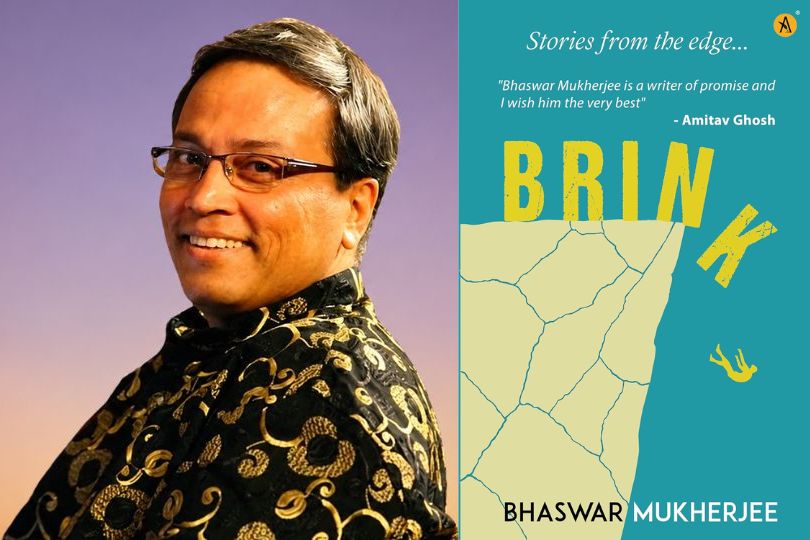
Frontlist: “Death has many faces” is the central premise of Brink. What first drew you to explore mortality as a unifying theme across thirteen very different stories?
Bhaswar: Life threw me a curveball in 2024, which sparked this journey of evaluating death using different lenses. I realised that in the past, subconsciously I had examined the many and distinct faces of Death. I realised that they were not necessarily all morbid, but could also be hope, closure, catharsis, nemesis, etc. Universally, every culture, every family, every individual confronts mortality. By placing thirteen different stories against that backdrop, I wanted to show how death could be release, not just rupture, a beginning, not just the end.
Frontlist: Several stories were shortlisted in Times of India’s Write India contest, written to prompts by authors like Amitav Ghosh, Ashwin Sanghi, and Nayantara Sahgal. How does writing to someone else’s prompt change your creative process compared to starting with a blank page?
Bhaswar: Writing to another author’s prompt was like entering a room where one piece of furniture had already been placed. The challenge of how I could use that furniture, move it around, blend it into the tapestry, create other artifacts, decoration, of a story/theme/genre became a heady pursuit. It was a great experience that forced me to stretch, to inhabit voices and situations I might not have chosen if I walked into an empty room. Paradoxically, perhaps, it unlocked unexpected creativity despite the constraint that I had to use that furniture without discarding or rebuilding it.
Frontlist: You call yourself an “accidental writer” after an eighteen-year banking career. What was the moment or trigger that pulled you from banking into storytelling?
Bhaswar: Though I dabbled in the usual desultory poems and prose in school and college, I guess the itch was always latent. Writing was a discovery by accident when I submitted a short story for a contest as a lark in 2014, and it got accepted. When many such submissions gained appreciation, I guess what started as catharsis became craft. I now write fiction (both long and short form), and nonfiction. However, I am not a full-time writer. I run a company which I had set up in 2005 after I quit the corporate world of banking.
Frontlist: Brink moves across literary fiction, crime, historical fiction, and genre fiction. Was it a deliberate choice to keep the collection genre-fluid, or did each story simply demand its own form?
The genre shifts were not deliberate; the stories demanded them. A crime narrative needed tautness, a historical tale demanded research and texture, while a psychological story required silence. To force them into one genre would have been dishonest to their emotional truth.
Frontlist: Among the thirteen stories, one where a soul longs for release, another where a wronged spirit seeks justice, do you have a personal favorite, and what makes it stand apart for you?
Bhaswar: That’s almost an impossible question to answer. Just as asking a mother her favorite child. Every story was bleeding my soul onto paper. If I was forced to choose, I would pick up “Retribution”, the last story in the book, for it has elements of love, thriller, and even autoscopy.
Frontlist: You’ve written both fiction and nonfiction, with your nonfiction titles becoming Amazon bestsellers. How differently do you approach research and craft when moving between the two?
In nonfiction, research is scaffolding; facts, judgments, documents. In fiction, research is atmosphere; the details that make a world believable. The discipline is similar, but the intent differs: research in nonfiction establishes the importance of credibility and authority or knowledge, while in fiction, though it lends credibility, it also persuades and immerses.
Frontlist: Your work has featured in anthologies curated by Sudha Murty and Ravinder Singh. How did those experiences shape your understanding of what makes a short story memorable?
Bhaswar: Being part of those anthologies taught me that a short story must linger beyond its last line. Readers may forget the plot, but they will remember the emotional residue. That residue is what makes a story memorable. That said, the selection of your story, no matter how good, is also a matter of fortune. A story better than mine could have lost out because of the sheer luck of the draw!
Frontlist: The book’s tagline suggests death can be “only the beginning”. Without giving away plot details, is there a story in Brink that changed your own perspective on mortality while writing it?
Bhaswar: There is a story in Brink– “An Autumn Leaf” where death becomes a doorway rather than an ending. While ideating around the prompt, I realised that we are taught lessons on how to live but almost no training or preparation on how to face death. Writing it shifted my perspective: that mortality is not necessarily closure, but transition. It reminded me that endings can be beginnings in disguise.
Frontlist: Co-founding Bridgepoint Solutions and building a career in engineering and finance seems far removed from literary fiction. Do you see any unexpected overlap between analytical, structured thinking and storytelling?
Bhaswar: Banking taught me nuances of structure and precision, while taking a leap of faith in my forties into entrepreneurship taught me risk taking. Storytelling sometimes demands the same: structure in narrative, precision in language, and the courage to take creative risks. The overlap is unexpected but real.
Frontlist: For readers who are new to your work and starting with Brink, which of your other four books would you recommend as a natural next read, and why?
Bhaswar: For readers starting with “Brink…Stories from the edge” and who like anthologies, I would suggest my earlier anthology, “it happens- Stories of Human Relationships”. For those preferring long-form fiction, “Scarred Earth” is a ‘must read’. If you prefer nonfiction, you could pick up “The Counterfeiter- Abdul Karim Telgi and the Stamp Scam” or “The Founding Fathers of Fraud”. Essentially, I would love readers to savour all my works!
Post a comment
0 comments

Trending Posts
.jpg)
.jpg)


.jpeg)

.jpg)
Recent Post
.jpg)
.jpg)


Related Post
 (1).jpg)


© 2026 - Frontlist - News and Updates of Publishing Industry, Book Reviews, Education News, Author Interviews, and Videos.. All Rights Reserved.
Sorry! No comment found for this post.