Interview with Anil Rajput, Author of The Dharma of Leadership: Lessons from Ramayana & Mahabharata
In this author interview, Anil discusses The Dharma of Leadership, exploring how lessons from the Mahabharata and Ramayana can guide modern leaders in ethical decision-making, resilience, institutional loyalty, honest counsel, and leadership with integrity.on Nov 13, 2026
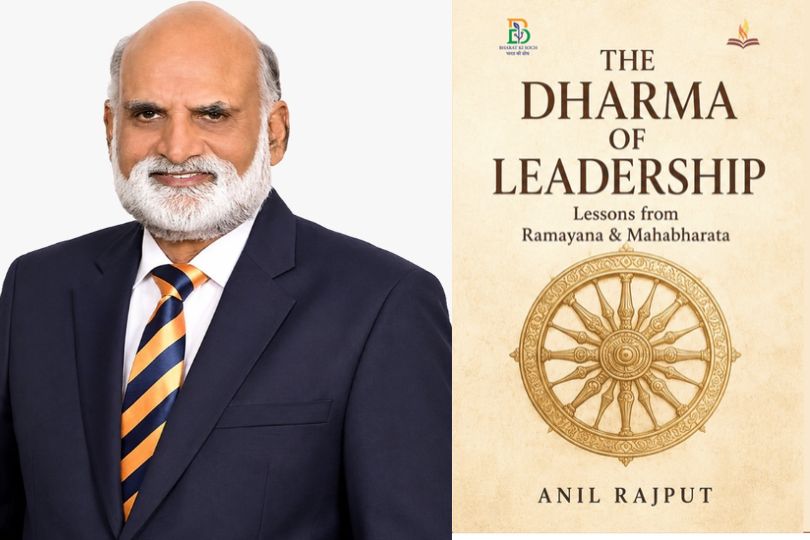
Frontlist: You spend your days in the boardroom as President, Corporate Affairs at ITC. What made you turn to Bhishma, Vidura, and Shabari for lessons on leadership, and was there a moment when an epic explained something that management frameworks could not?
Anil: Throughout my professional life, I have believed that leadership is not merely about achieving objectives but also about the values and principles that guide our decisions. Our epics offer a wealth of lessons, not only through the successes of their characters but also through their mistakes and the consequences of their choices.
Bhishma teaches us about the complexities of institutional loyalty, Vidura about the importance of honest counsel, and Shabari about dedication and commitment without expectations. These lessons remain as relevant today as they were centuries ago.
I would not attribute this understanding to one particular moment. Rather, experience has reinforced my belief that while management frameworks help us determine how to achieve our objectives, our epics often help us reflect on whether the path we have chosen is the right one. The idea behind the book is to draw upon this wisdom and apply it to the challenges of modern leadership.
Frontlist: Bhishma is admired for his vows, yet he stayed silent during Draupadi's humiliation. Is he a model of leadership or a warning about loyalty without courage?
Anil: Bhishma's vow was intended to protect the institutional dharma of Hastinapura, and his loyalty remained steadfast towards whoever occupied the throne. However, during Dhritarashtra's reign, Bhishma recognised on several occasions that the king's affection for Duryodhana had resulted in injustices that were not expected of a ruler committed to dharma.
The episode involving Draupadi offers an important lesson. One should never take a vow so absolute that it eventually compels one to stand alongside adharma. For me, therefore, it is not a question of loyalty without courage. Rather, it is about understanding the consequences of an all-encompassing commitment that may leave an individual unable to stand on the side of dharma when circumstances demand it.
A vow, however noble its intention, should never become an obstacle to doing what is right.
Frontlist: Vidura spoke the truth and was largely ignored. What should a leader do when they are the Vidura in the room, and what should a CEO do to make sure a Vidura is in the room at all?
Anil: In the corporate world, you always need a Vidura, someone who consistently shows you the other side of the mirror and offers a perspective that may differ from your own. It is ultimately for the CEO to consider that advice, accept it or overrule it.
However, the absence of a Vidura can be catastrophic for any organisation. A leader surrounded only by yes-men will never have the benefit of an independent or opposing viewpoint. Equally, those who find themselves in Vidura's position must have the conviction to offer honest counsel, even when it is uncomfortable.
The strength of leadership lies not in having everyone agree with you, but in ensuring that different perspectives are heard before a decision is taken.
Frontlist: What can leaders learn from Shabari, Sudama and Hanuman, who led through service rather than authority?
Anil: In life, and particularly within any organisation, you need people who perform their responsibilities with complete dedication, commitment and integrity. No institution or company can succeed unless it has individuals who discharge their duties with diligence, without constantly seeking personal recognition or rewards.
Shabari, Sudama and Hanuman exemplify these qualities through their humility, sincerity, devotion and commitment to a larger purpose. Their examples remind us that an individual's contribution is not determined by the authority they possess, but by the dedication with which they fulfil their responsibilities.
Such individuals form the foundation of strong and enduring institutions.
Frontlist: You write about restraint as leadership. In a world that rewards speed and disruption, when is not acting the harder, braver choice?
Anil: Speed is undoubtedly important in today's fast-paced world, and disruption is often necessary to remain ahead in an increasingly competitive environment. However, it is not an either-or situation. There are circumstances in which restraint is the most appropriate course of action to achieve eventual success.
I firmly believe that leaders must have restraint as a potent weapon in their armoury. When the tide is against you, there are times when the wiser course is to exercise patience, reassess the situation and act when circumstances become more favourable.
Restraint is not a sign of weakness or indecision. It is the ability to recognise when waiting, rather than acting immediately, will serve the larger objective.
Frontlist: Abhimanyu entered the chakravyuha knowing how to get in but not how to get out. What is the corporate or policy equivalent today?
Anil: Abhimanyu's entry into the chakravyuha must also be understood in the context of timing and strategic necessity. In the corporate world, there are situations when gaining time becomes critical to achieving the ultimate objective. Diversion and disruption can be important strategic tools in such circumstances.
On the day Abhimanyu entered the chakravyuha, the Pandavas faced an extremely difficult situation. They had to overcome the immediate challenge before them, even though the decision exposed Abhimanyu to extraordinary danger and ultimately cost him his life.
Similarly, in the corporate world, circumstances may demand difficult strategic choices or short-term sacrifices to safeguard a larger objective. Whether such an approach is appropriate depends entirely on the situation, the stakes involved and the consequences of the decision.
The larger lesson is that strategy is not merely about what action is taken, but also about when and under what circumstances it is undertaken.
Frontlist: Your chapter on "intellect without dharma" suggests brilliance alone can be a liability. Which modern examples, in business, technology or public life, come to mind?
Anil: Many disruptive technologies and the widespread use of social media are remarkable achievements of human intellect. However, they also bring consequences that must be carefully understood and addressed.
Take online shopping and online banking, for example. These innovations have transformed convenience and accessibility for consumers. At the same time, their misuse has created challenges such as cybercrime, online fraud and the sale of counterfeit products.
The lesson is that intellectual brilliance and technological advancement must be accompanied by responsibility and ethical judgement. The ability to create something extraordinary does not absolve us of the responsibility to consider how it may be used and what consequences it may have for society.
Frontlist: Critics may say epics offer inspiring stories but not measurable management frameworks. How do you respond, and how do you stop "ancient wisdom" from becoming a slogan leaders quote but never practise?
Anil: The fundamental idea is to draw meaningful lessons from these stories. These include not only examples of what was done right, but equally important lessons about what went wrong, so that we do not repeat those mistakes in the modern world.
I firmly believe that the future is built on the strength of our history, because history provides us with the benefit of understanding both what worked and what did not. The objective should be to adopt what proved valuable and learn to avoid what led to failure.
Our epics are not intended to replace modern management frameworks. They offer insights that can strengthen judgement and guide decision-making. Their relevance lies in how effectively we apply these lessons in our actions, rather than merely quoting them as examples of ancient wisdom.
Frontlist: If a reader remembers only one idea from The Dharma of Leadership ten years from now, what do you hope it is?
Anil: The most important quality in life is resilience. Whether you are working in an institution, leading an organisation or pursuing a personal objective, there will inevitably be ups and downs, successes and setbacks.
What matters is that your commitment, integrity and loyalty to the values you stand for remain intact, irrespective of the circumstances you face.
Circumstances will change, challenges will arise, and setbacks may test your resolve. But resilience, supported by integrity and unwavering commitment, is what enables you to persevere and ultimately succeed.
Post a comment
0 comments

Trending Posts









Recent Post








Related Post


 (1).jpg)




© 2026 - Frontlist - News and Updates of Publishing Industry, Book Reviews, Education News, Author Interviews, and Videos.. All Rights Reserved.
Sorry! No comment found for this post.