Interview with Aakash Mehrotra, Author of Out of My Oyster
Aakash Mehrotra discusses Out of My Oyster, queer storytelling, mental health, representation, and the future of LGBTQIA+ literature in India.on Jun 29, 2026
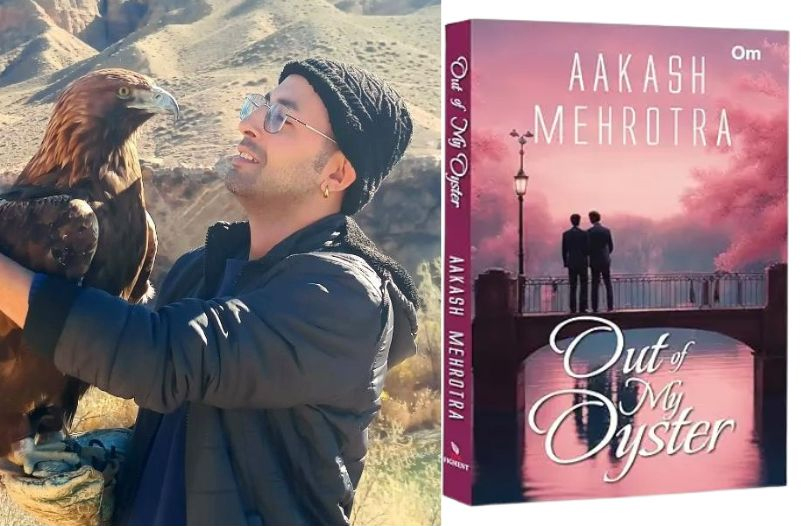
Frontlist: Anuj appears in both your novels - is he your alter ego, or a character you needed to follow to his next chapter?
Aakash: I won’t use either of the words for Anuj. Out of my Oyster could have been a story without Anuj too, but I did feel there needs to be ‘what after’ Anuj and Nikhil got together in ‘The Other Guy’. Thus, you may say Out of My Oyster became that next chapter. Through Anuj and Nikhil’ chemistry in this book, I also wanted to show how seemingly perfect relationships can hide imperfections in them which grow with time. As for the character of Anuj, I’d say that like most writers, I have lent him parts of my experiences, observations, fears, and hopes in his character, but he has always had a life of his own. When I finished The Other Guy, I felt there was still more to say about him. His coming-out journey was only one part of his story. I wanted to explore what happens after acceptance begins, and how people carry scars, navigate relationships, and continue growing.
Frontlist: You wrote The Other Guy when same-sex relations were still criminalized in India. What did it feel like to hit publish knowing that?
Aakash: It felt both terrifying and liberating. At the time, there were very few Indian queer stories that felt relatable to me, and certainly not many that explored everyday queer lives. Publishing a book felt like stepping into the open and saying, "Our stories need to be there." There was uncertainty about how people would react, but there was also a sense that silence was no longer an option. The book was my way of contributing to a conversation that needed to happen. The journey of publishing it was also enthralling: with rejections basically because of the subject of the story pouring in, and a spectrum of reactions from my known ones with some even cautioning me to write on something that’s criminalized or even not going too political with it.
Frontlist: Your second book goes deeper - trauma, abuse, mental health. Was that always the plan, or did Anuj's story demand it?
Aakash: It wasn't a conscious plan when I wrote the first book. As I continued thinking about Anuj and the people around him, I realized that coming out does not magically resolve life's complexities. Many queer individuals carry invisible burdens - family rejection, bullying, internalized shame, loneliness, or trauma. Anuj's story demanded honesty, and honesty meant engaging with difficult themes. I wanted to explore not just survival, but healing. And then the character of Aarya was shaped: stories of abuse generally remain unspoken of, but these incidents shape our lives. With Aarya’s character I wanted to touch on that aspect of healing, and trauma shaping our lives. And as Anuj’s character had evolved in both ‘The Other Guy’ and ‘Out of my Oyster’ – that added more depth to the storytelling, while doing justice to the gravity Anuj carried within himself.
Frontlist: You've said your words are "an outlet for an entire community." Does that responsibility ever feel like a weight?
Aakash: I feel every word written, or any artistic expression is an ‘outlet for an entire community’. Because through literature and art, we tell stories. No single writer or expression can represent the diversity of queer experiences, and I am always conscious of that. At the same time, I see my role less as speaking for a community and more as adding one voice to a larger chorus. The responsibility motivates me to write truthfully and compassionately. If readers see parts of themselves in my work, that is a privilege rather than a burden.
Frontlist: This issue's theme is "Stories That Claim Space." What space do you feel Indian queer literature still hasn't claimed?
Aakash: I think Indian queer literature still has vast unexplored territory. We need more stories from small towns, more stories in regional languages, more narratives about aging, family life, parenthood, friendship, and ordinary existence. Queer stories are often expected to focus on struggle or coming out. Those stories are important, but queer people also fall in love, travel, build careers, raise families, and grow old. The space that remains to be claimed is the space of everyday normalcy.
Frontlist: You grew up with no queer books to relate to. If a 15-year-old queer kid in India reads your work today, what do you hope they feel?
Aakash: I hope they feel seen and understood. I hope they realize that their feelings are valid, that they are not alone, and that there is nothing unusual about who they are. Most importantly, I hope they see possibilities and be able to see hope. When I was growing up, it was difficult to imagine a future as a queer person. If my books help even one young reader believe that they can have love, happiness, and a fulfilling life, then they've done their job. I feel the biggest change between then and now is that space now exists: there is still a lot to be done to make that space speak to every person, but there is a possibility.
Frontlist: Your day job is in financial technology, you're a travel writer, and you write queer fiction. How do all these lives coexist in one person?
Aakash: To me, they are all expressions of curiosity. My professional work satisfies my analytical side. Travel writing allows me to explore places, cultures, and histories. Fiction lets me explore emotions, identities, and human relationships. They may all seem unrelated, but they stem from one common desire, that is to understand people and the world around me, and to tell stories about what I discover.
Frontlist: What's the story you haven't written yet - the one still waiting?
Aakash: I do want to write a story that moves beyond identity as its central theme. I would love to write a sweeping novel where queer characters exist naturally within the narrative, without their sexuality being the defining conflict. Perhaps a story about family, friendship, or any aspect of life - I am not so sure at this stage. And I don't know exactly what shape it will take, but I know it's something I’d like to do, and it’s quietly waiting for the right moment to emerge.
Post a comment
0 comments

Trending Posts
.jpg)
.jpg)


.jpeg)

.jpg)
Recent Post
.jpg)
.jpg)


Related Post
 (1).jpg)



© 2026 - Frontlist - News and Updates of Publishing Industry, Book Reviews, Education News, Author Interviews, and Videos.. All Rights Reserved.
Sorry! No comment found for this post.