The Supreme Alignment: Sri Vishnu Sahasranama for Your Nakshatra
A review of The Supreme Alignment, exploring Vedic wisdom, astrology, and the Vishnu Sahasranama as a framework for inner alignment and leadership.on Aug 22, 2026
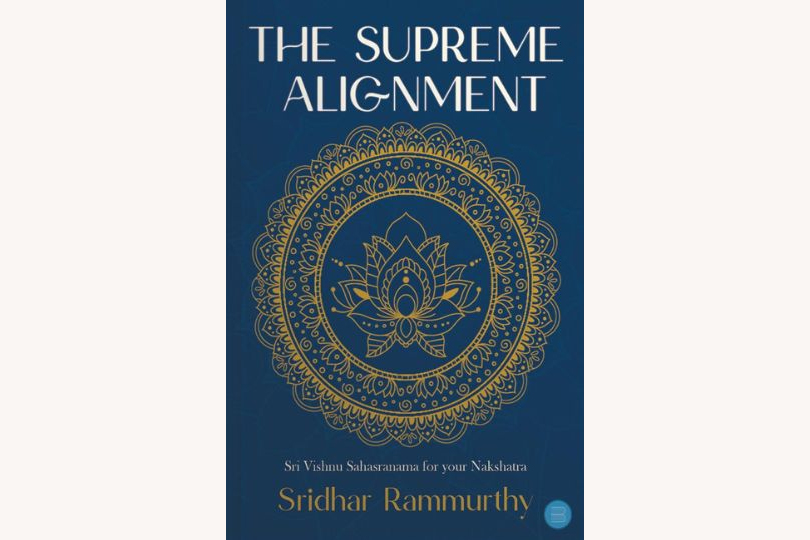
The Supreme Alignment
What does it take to become a truly effective leader? Is leadership primarily a matter of competence, ambition and decision-making, or does it begin with something deeper—the ability to govern oneself?
Sridhar Rammurthy’s The Supreme Alignment approaches this question through an unusual intersection of the Vishnu Sahasranama, Vedic astrology, contemplative practice and contemporary ideas of leadership and behavioural development. Rather than treating the Vishnu Sahasranama solely as a devotional hymn, the book presents it as a framework for inner development, with the larger proposition that sustainable outer leadership must emerge from inner alignment.
The book’s central argument is introduced through the story of Yudhishthira approaching Bhishma after the Kurukshetra war. Having won the kingdom but carrying guilt, doubt and moral exhaustion, Yudhishthira’s concern is not simply how to rule, but how to remain righteous while exercising authority. Rammurthy interprets Bhishma’s response-the thousand names of Vishnu-as a form of inner governance. In the author’s framing, leadership begins with consciousness and character before it manifests as institutional or social authority.
From Devotion to Inner Governance
One of the book’s strongest ideas is its reinterpretation of spiritual practice as a discipline of character formation. Rammurthy argues that repeatedly contemplating the qualities represented by the names of Vishnu can help cultivate qualities such as patience, courage, compassion, balance, wisdom and responsibility.
This gives the book a clear leadership-development dimension. The Vishnu Sahasranama is presented not simply as something to recite, but as something to contemplate and translate into behaviour. The book recommends a practical approach: regular recitation, studying a small number of names, self-reflection and behavioural application. In this formulation, spirituality becomes an intentional practice rather than an activity separated from everyday life.
The book further connects this practice with the movement from reaction to reflection. Its argument is that repetitive chanting and contemplation can create a pause between stimulus and response, encouraging greater awareness before action. For leadership, this becomes particularly relevant: the ability to respond rather than react is presented as a foundation for emotional intelligence, ethical decision-making and stable authority.
The Nakshatra Framework
The distinctive feature of The Supreme Alignment is its extensive use of the 27 Nakshatras and their four padas as a framework for understanding individual patterns.
Rammurthy is careful, at least within the book's own framework, to distinguish a Nakshatra from fixed destiny. The book describes it as a pattern or starting configuration that may influence tendencies, reactions and recurring behavioural patterns, rather than as an absolute determinant of one's life. It then places Nakshatra alongside two other concepts-Karma and Guna-to create a broader model of human behaviour.
The distinction is important. Two people may share the same Nakshatra yet experience very different lives because their karma, qualities of response and level of awareness can differ. The book therefore moves away from a simplistic astrological determinism and towards a model in which awareness and practice create room for change.
The book then maps the 27 Nakshatras to 108 verses of the Vishnu Sahasranama, with each Nakshatra's four padas corresponding to four verses. Readers who know their Janma Nakshatra and pada are invited to identify the corresponding verse and engage with it through regular recitation and contemplation. For readers who do not know their Nakshatra, the book presents the devotional practice of chanting all 108 verses.
Importantly, the author explicitly notes that this particular Nakshatra–Sahasranama mapping is a later devotional tradition rather than a framework explicitly found in the critical edition of the Mahabharata. That distinction adds useful context to the book's presentation of the system.
27 Nakshatras, 27 Patterns of Self-Reflection
The bulk of the book explores the individual Nakshatras, examining their perceived strengths, possible imbalances and ways in which the Sahasranama can be used as a corrective or balancing practice.
For example, Ashvini is associated with beginnings, speed and initiative. Its strength is decisive action, while its potential imbalance is restlessness, impatience and difficulty sustaining projects. The proposed correction is not to suppress Ashvini's energy but to give it continuity and direction.
Similarly, Bharani is presented through the idea of responsibility and containment. Its strengths include endurance, emotional depth and dependability, while its shadow can involve emotional overload, excessive responsibility and difficulty releasing control. The book proposes that devotional practice can help transform endurance into a more balanced form of responsibility.
Krittika, meanwhile, is associated with discernment, standards and sharpness. Its potential imbalance appears as harsh criticism, rigidity and excessive self-judgment. The book's suggested transformation is particularly relevant to leadership: maintaining standards while adding empathy, warmth and humility.
This pattern continues throughout the book. Each Nakshatra is examined through different areas of life, including health, relationships, career, finance and spiritual life, before the relevant Vishnu Sahasranama verses are introduced with their meanings and corresponding leadership lessons.
This structure makes the book function partly as a reference work. Readers can move beyond a general reading and return to the section associated with their own Nakshatra for more focused reflection.
The Book's Contemporary Vocabulary
Another notable aspect of The Supreme Alignment is its attempt to create a bridge between traditional spiritual vocabulary and contemporary leadership language.
Concepts such as identity, emotional regulation, systems thinking, behavioural patterns, self-reflection and cognitive development appear alongside Nakshatra, Karma, Guna and the Vishnu Sahasranama. The author also draws from leadership and behavioural literature, including works associated with Stephen Covey, Mihaly Csikszentmihalyi, Viktor Frankl, Daniel Goleman and Peter Senge. The bibliography also lists references in neuroscience and contemplative studies.
This interdisciplinary ambition gives the book its contemporary character. It is not written exclusively for readers approaching the Vishnu Sahasranama from a traditional devotional perspective. It also attempts to speak to readers interested in leadership, self-development and personal transformation.
At the same time, readers should understand that the book's references to neuroscience and behavioural science function within the author's larger spiritual framework. The work is fundamentally a synthesis of spiritual, astrological, philosophical and leadership perspectives rather than a conventional empirical study.
The Idea of Grace
The book's philosophical framework ultimately moves beyond Nakshatra, Karma and Guna to introduce Grace as the highest principle.
According to the book's model, Nakshatra represents pattern, Karma represents momentum and Guna represents the quality of one's response. Conscious practice provides an avenue for intervention, but Grace represents something beyond these structures. The book therefore avoids ending with the idea that human beings can engineer every aspect of their lives through effort alone.
This becomes one of the book's deeper philosophical propositions: self-development requires effort, awareness and discipline, but transformation cannot always be reduced to technique. The final movement is towards alignment and surrender.
A Book for Readers Interested in Spirituality and Leadership
The Supreme Alignment will likely appeal most strongly to readers who are comfortable exploring spirituality through a contemporary personal-development lens. Those already familiar with the Vishnu Sahasranama, Vedic astrology or Indian philosophical traditions will find a substantial amount of material to engage with, while readers approaching these subjects for the first time can use the book's structured Nakshatra chapters as an introduction.
Its greatest strength lies in its integrative ambition. Rather than isolating spirituality from professional life, relationships or personal development, Rammurthy repeatedly asks how inner qualities influence the way people lead, decide, respond to pressure and relate to others.
The book's practical orientation is also valuable. Readers are not simply given philosophical propositions; they are encouraged to establish a practice involving recitation, contemplation, self-observation and behavioural application.
For readers seeking a conventional book on corporate leadership, however, the extensive spiritual and astrological framework may feel unconventional. Likewise, readers looking for a strictly textual or traditional study of the Vishnu Sahasranama may find the book's contemporary interpretations and leadership-oriented applications different from a classical commentary.
But that difference is also the book's defining feature.
Final Verdict
At its heart, The Supreme Alignment is a book about inner governance.
Its central proposition is simple but consequential: authority over others has little value if one has not developed authority over oneself. The book takes this idea and builds an extensive framework around the Vishnu Sahasranama, connecting it with Nakshatras, Karma, Guna, leadership, self-reflection and conscious practice.
Its closing philosophy returns to the same principle with which the book began: before attempting to govern institutions, teams or communities, a person must first develop the capacity to govern their own inner world. The book argues that sustained contemplation can help reshape identity, regulate emotional responses, clarify values and bring action closer to conscience.
For readers interested in Indian spiritual traditions, Vedic astrology, conscious leadership and self-development, The Supreme Alignment offers an ambitious and distinctive synthesis. It invites its readers not merely to acquire knowledge about the Vishnu Sahasranama, but to experiment with it as a daily discipline and examine what changes when ancient devotional practice is brought into contemporary life.
About the Author

Sridhar Rammurthy: Business Leader, Scriptural Strategist and Author
Sridhar Rammurthy is an Indian business leader, scriptural strategist, leadership coach, and author known for connecting ancient Bharatiya wisdom with modern leadership, decision-making, and organisational performance.Sridhar Rammurthy is a senior business leader and Indian author with more than 25 years of experience across insurance, management consulting, product development, and leadership transformation. Throughout his corporate career, he has worked on product innovation, distribution, channel transformation, and capability development at an enterprise level.An alumnus of the UCLA Anderson School of Management, Sridhar has worked closely with senior executives, C-suite leaders, and large organisations. His approach combines structured…
Read more about Sridhar Rammurthy: Business Leader, Scriptural Strategist and Author →Post a comment
0 comments

Trending Posts
.jpg)
.jpg)



.jpeg)


.jpg)

Recent Post
.jpg)
.jpg)





Related Post






© 2026 - Frontlist - News and Updates of Publishing Industry, Book Reviews, Education News, Author Interviews, and Videos.. All Rights Reserved.
Sorry! No comment found for this post.