Stories from the Fourth State: A Review of Plasma Science and Its Real-World Applications
A review of Prof. John Pucadyil’s Stories from the Fourth State, exploring how plasma science moves from the laboratory into energy, agriculture, industry, food, and cultural conservation.on Sep 27, 2026
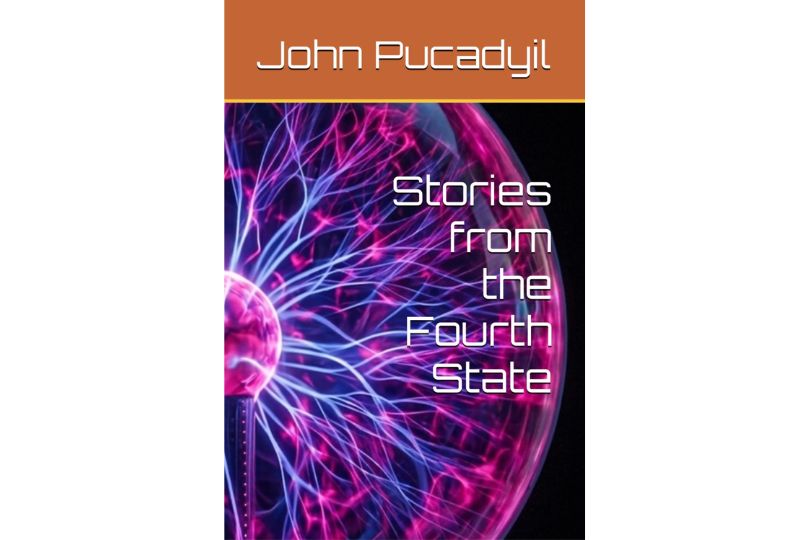
Stories from the Fourth State: How Plasma Science Transforms Technology and Everyday Life
Stories from the Fourth State by Prof. John Pucadyil offers a fascinating journey from the controlled environment of the physics laboratory to the places where scientific innovation meets everyday life. Centred on plasma—the fourth state of matter—the book brings together a series of vivid, human-focused narratives showing how advances in plasma technology can influence industries as diverse as hydropower, agriculture, food preservation, clean energy, environmental remediation, manufacturing, art conservation and gastronomy.
Rather than presenting plasma physics only through equations, experiments or technical descriptions, Prof. Pucadyil approaches the subject through stories. Each narrative is centred around a person affected by a particular technological application, making the connection between fundamental science and practical transformation easier to appreciate.
Book Summary
At the heart of Stories from the Fourth State is a simple but powerful idea: scientific discoveries can move far beyond the laboratory and quietly reshape the world around us.
Plasma, often described as the fourth state of matter, has applications that extend well beyond conventional ideas of high-energy physics. The book explores how the controlled use of plasma processes can modify materials, generate energy, improve agricultural practices, preserve food, treat industrial surfaces, address environmental challenges and even protect works of art.
The stories move across different geographical and industrial settings. In the Himalayan region, plasma nitriding is used to strengthen stainless-steel turbine components exposed to destructive quartz silt in hydropower systems. In Pune, Advanced Active Screen Plasma Nitriding (ASPN) is applied to heavy-duty power plant shafts, demonstrating how plasma can alter material surfaces for demanding industrial environments.
Agriculture provides another striking example. On paddy fields in Tamil Nadu, non-thermal cold-plasma discharges can transform air and water into a localized source of nutrients, described in the book as "lightning water." Plasma-based processes are also explored for decontaminating spices such as black pepper and cardamom while preserving their delicate volatile oils.
The book then moves into some of the most pressing questions surrounding sustainability. In Punjab, plasma gasification is presented as a method of converting rice stubble into fuel-grade green hydrogen. Other stories explore plasma-catalytic reactors that can transform captured carbon dioxide into useful products such as syngas and liquid methanol using solar energy.
From energy and agriculture to traditional crafts and cultural conservation, the applications continue to expand.
What Makes Stories from the Fourth State Different?
The distinctive feature of the book is its story-driven approach to science.
Plasma physics can initially seem remote from ordinary experience. Prof. Pucadyil bridges that distance by focusing on people, places and practical problems. Instead of asking readers to encounter plasma only as an abstract scientific concept, the book shows what happens when plasma processes are brought into contact with real-world challenges.
This approach also reveals the multidisciplinary character of plasma technology. The same underlying science can be used to strengthen turbine components, improve industrial materials, support agriculture, process food, produce cleaner fuels, conserve paintings and develop sustainable manufacturing techniques.
The book therefore becomes more than a collection of technological case studies. It is an exploration of how fundamental science becomes useful technology.
Themes in Stories from the Fourth State
From Fundamental Physics to Applied Technology
One of the central themes is the movement of knowledge from basic scientific research into practical applications.
The stories demonstrate that a concept investigated in a laboratory can eventually influence factories, farms, power plants, museums and kitchens. Plasma becomes the link between fundamental physics and technological problem-solving.
Plasma and Sustainable Industry
Several applications described in the book relate directly to sustainability.
Plasma technologies are explored in connection with rice-stubble management, hydrogen production, carbon dioxide conversion, material protection and reduced erosion. The emphasis is not simply on technological sophistication but on how scientific processes can potentially address resource, environmental and energy challenges.
Innovation in Agriculture and Food
The agricultural and food-related stories demonstrate that plasma technology does not belong exclusively to heavy industry.
Cold plasma applications in agriculture, including the creation of nutrient-rich "lightning water," show how plasma can interact with biological and environmental systems. Food preservation and decontamination applications involving black pepper and cardamom further illustrate how technology can be adapted to protect both safety and quality.
Preserving Art and Cultural Heritage
One of the more unexpected dimensions of the book is its exploration of plasma in conservation.
Atomic oxygen showers are used to gently remove heavy soot from fire-damaged paintings while avoiding direct contact with the fragile pigments underneath. Elsewhere, plasma processing is applied to Moradabad brassware to create protective coatings that help prevent tarnishing.
These examples broaden the reader's understanding of what technological innovation can accomplish. Plasma is not simply about machines, reactors or industrial production; it can also contribute to preserving objects connected to human creativity and cultural heritage.
Advanced Materials
The book also examines how plasma processes can alter and enhance the surfaces and structures of materials.
Applications include modifying Kulu Valley Angora wool to facilitate pure spinning, changing the atomic lattice of natural diamonds to create stable colour enhancements, and applying diamond-like carbon coatings to industrial components to reduce erosion and material loss.
The discussion of synthetic diamonds takes the concept even further, exploring how pure single-crystal laboratory diamonds can be grown atom by atom through Methane Chemical Vapor Deposition (CVD).
Clean and Carbon-Neutral Energy
Energy is another significant area explored through the stories.
The book discusses compact Z-pinch fusion reactors designed to compress plasma columns using sheared flow, reflecting the continuing pursuit of fusion as a potential low-carbon energy source. It also looks at plasma-catalytic DBD reactors that can use captured carbon dioxide and solar energy to produce syngas and liquid methanol.
These narratives place plasma science within some of the major technological conversations surrounding energy transition and carbon management.
Plasma Science in Unexpected Places
Perhaps one of the most engaging aspects of Stories from the Fourth State is the range of settings in which plasma appears.
Readers encounter plasma in hydropower turbines, industrial shafts, paddy fields, food processing systems, hydrogen production facilities, energy research, denim manufacturing, brassware conservation, museums, wool processing, diamonds and even gastronomy.
The story of preparing a steak with a thin crust using a modified plasma torch is particularly illustrative of the book's broader philosophy. It demonstrates how a technology associated with advanced scientific research can be adapted to an entirely different context.
This variety reinforces an important message: innovation often emerges when scientific principles are applied beyond their original boundaries.
Writing Style
Prof. John Pucadyil's approach combines scientific knowledge with narrative storytelling. The technical foundation remains central, but the book's stories are designed around applications and human experiences rather than presenting plasma physics as an isolated academic discipline.
This makes Stories from the Fourth State particularly interesting for readers who want to understand not only what plasma is, but what it can do.
The geographical diversity of the narratives also gives the book a broader perspective. From the Himalayan rivers and Tamil Nadu's agricultural fields to industrial centres such as Pune and Gandhinagar, the stories demonstrate how scientific innovation interacts with different environments and industries.
About the Author
Prof. John Pucadyil is a plasma physicist, institution builder, professor and author whose career spans more than five decades across research, development and teaching.
Originally from Kottayam, Kerala, he earned his Ph.D. from Aligarh Muslim University in 1969, having begun plasma experiments using self-assembled equipment. He joined the Physical Research Laboratory in 1972 and contributed to the resurgence of experimental plasma physics in India.
Prof. Pucadyil played a role in the development of India's fusion research and in the establishment of the Institute for Plasma Research (IPR). He was also part of the team behind ADITYA, India's first indigenous tokamak reactor, and contributed to industrial plasma applications that led to the establishment of the Facilitation Centre for Industrial Plasma Technologies (FCIPT).
His international career included serving as Head of the Physics Division at the International Atomic Energy Agency (IAEA), where he coordinated international cooperation in plasma physics and thermonuclear fusion research. He was also involved in the technical negotiations that initiated India's partnership in the global ITER fusion project.
Beyond research, Prof. Pucadyil has mentored scientists through the Satellite Research Projects and the National Fusion Programme. He is currently a Professor of Practice at Mahatma Gandhi University in Kottayam, where he mentors young entrepreneurs through the MG University Innovation Foundation.
His interests extend beyond science. He is also an oil painter and poet and writes about life, science, technology and society. His other books include Plasma Sciences and the Creation of Wealth, Plasma Processes for Energy and Environment, and the memoir Experiments with Plasmas.
Who Should Read Stories from the Fourth State?
Stories from the Fourth State can appeal to a broad range of readers, including:
- Students and researchers interested in plasma physics and fusion science
- Readers curious about the practical applications of advanced technology
- Engineers and technology professionals
- Readers interested in clean energy and sustainable technologies
- Those exploring innovations in agriculture and food preservation
- Anyone interested in advanced materials and industrial processes
- Readers fascinated by science and cultural heritage conservation
- Students interested in the journey from scientific research to technological innovation
- General readers who enjoy science presented through real-world stories
The book can also serve as an accessible window into the work of a scientist who has witnessed several stages of India's development in experimental plasma physics and fusion research.
Conclusion
Stories from the Fourth State presents plasma science through its consequences in the real world. Its stories demonstrate how the fourth state of matter can move from laboratory experiments into applications that affect energy, agriculture, manufacturing, environmental management, food, materials, art and even cuisine.
What emerges from these narratives is a picture of science as an evolving bridge between discovery and human need. Plasma processes are presented not merely as sophisticated scientific tools, but as technologies capable of addressing practical problems and opening new possibilities.
For readers interested in plasma technology, fusion research, sustainable innovation, advanced materials and the practical applications of modern science, Prof. John Pucadyil's book offers an engaging journey across disciplines. At its core, Stories from the Fourth State is about what happens when fundamental physics leaves the laboratory and begins interacting with the world around us.
Post a comment
0 comments

Trending Posts
.jpg)
.jpg)


.jpeg)
.jpg)
Recent Post


.jpg)
.jpg)


Related Post



© 2026 - Frontlist - News and Updates of Publishing Industry, Book Reviews, Education News, Author Interviews, and Videos.. All Rights Reserved.
Sorry! No comment found for this post.