The Mangalyaan Trilogy: A Gripping Science Fiction Saga of Mars, Power, and Humanity
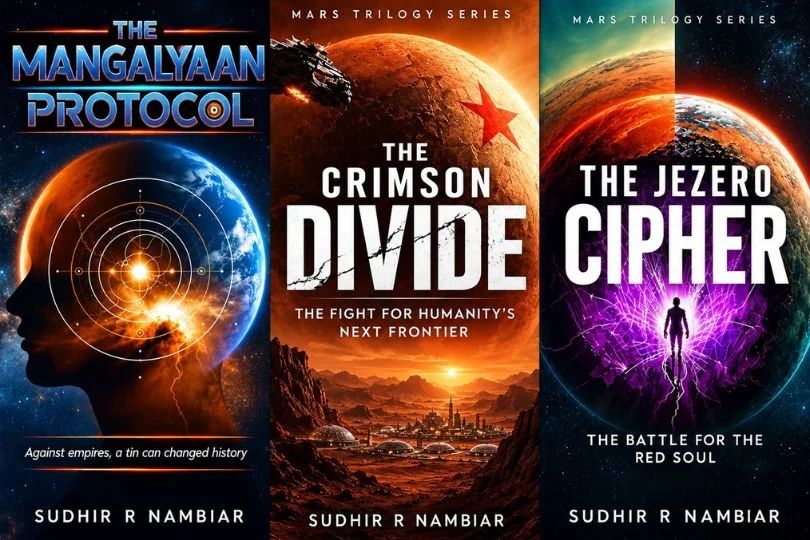
Explore Sudhir's Mangalyaan Trilogy, featuring The Mangalyaan Protocol, The Crimson Divide and The Jezero Cipher-an Indian science fiction saga of Mars, politics and cosmic mysteries.on Nov 02, 2026
Introduction
What happens when the world's most powerful nations decide that the future of space exploration belongs exclusively to them? And what if an underdog challenges their ambitions with limited resources, extraordinary ingenuity, and the courage to imagine something bigger?
Sudhir's three-book science fiction series, beginning with The Mangalyaan Protocol, followed by The Crimson Divide and The Jezero Cipher, builds an expansive narrative around these questions. Moving from a high-stakes race to Mars to the political and existential challenges of establishing a human colony, the trilogy explores the intersection of space exploration, international power struggles, technological ambition, and humanity's place in the universe.
At the centre of the story is Dr. Vihaan Aryavart, whose determination to take India into the race for Mars challenges the dominance of global superpowers. As the narrative progresses, the stakes expand beyond national rivalry. The colonisation of Mars exposes the divisions within human society, while the discovery of an ancient planetary intelligence transforms the mission into a struggle involving the future of an entire world.
Across its three instalments, the series combines political intrigue, scientific speculation, military conflict, and cosmic mystery. It is a story about ambition and survival, but also about the difficult choices humanity must confront when it ventures beyond the boundaries of Earth.
Book One: The Mangalyaan Protocol – An Underdog's Race to Mars
The trilogy begins with a provocative geopolitical premise. Washington and Beijing have secretly signed a treaty to dominate space exploration, believing that their financial resources, technological capabilities, and military strength have secured their position in the race for the stars.
Their calculations, however, overlook Dr. Vihaan Aryavart.
Determined to challenge the established order, Vihaan leads India's attempt to reach Mars using the Vajra, an inexpensive spacecraft that stands in sharp contrast to the sophisticated resources available to the superpowers. The mission represents more than a scientific achievement. It is a challenge to the assumption that only the wealthiest and most powerful nations can shape humanity's future in space.
As the Vajra moves towards the Red Planet, the political situation becomes increasingly dangerous. Realising that they may lose control of the space race, the superpowers resort to increasingly aggressive measures to eliminate the competition.
The story moves from the chaotic streets of Mumbai to the unforgiving environment of space, including the terrifying prospect of a spacewalk under laser fire. This combination of terrestrial political manoeuvring and high-risk space action gives the opening book its thriller-like momentum.
The Mangalyaan Protocol establishes the trilogy's central ideas: innovation can challenge established power, national ambition can carry enormous consequences, and the future may belong to those willing to take risks that others consider impossible.
Book Two: The Crimson Divide – The Fragile Dream of a Martian Colony
If the first book is about reaching Mars, the second asks a more complicated question: what happens after humanity gets there?
Two years after the events of the first instalment, Dr. Vihaan Aryavart, pilot Zara Khan, and their crew have achieved the extraordinary feat of establishing the first human colony on Mars. Jezero City stands as a symbol of human ingenuity and independence, but its survival is far from guaranteed.
The initial excitement of colonisation begins to give way to familiar human problems. Resource scarcity, cultural differences, political ambitions, and internal disagreements threaten the fragile unity of the settlement. A series of unexplained incidents, including sabotaged power grids and disappearing water supplies, pushes the colony towards chaos.
The situation becomes even more complicated with the arrival of the Russian heavy-cruiser Bogatyr, carrying advanced terraforming technology and a heavily armed security force. Earth's superpowers continue to view the Martian colony as a strategic asset, and the possibility of restoring their control becomes an increasingly serious threat.
Vihaan and Zara must navigate a difficult political environment while confronting the possibility of a civil war. Their unexpected Russian allies become important to the struggle to uncover the forces behind the sabotage and protect the colony's independence. The mysterious Lazarus Directive adds another layer of danger, threatening to erase the progress made by the settlers.
Yet the political conflict is only part of the story. Beneath Jezero City, the colony's activity has disturbed something ancient. An indigenous Martian life form, possessing intelligence and hostility beyond human expectations, begins to emerge.
This development significantly expands the trilogy's scope. Mars is no longer simply a new home that humanity must learn to inhabit. It may be a living world with its own history, intelligence, and capacity to resist human interference.
The Crimson Divide therefore shifts the focus from the achievement of colonisation to the difficulties of building a sustainable society. It explores how the divisions humanity carries from Earth can threaten even the most extraordinary collective achievements.
Book Three: The Jezero Cipher – The Ancient Secret Beneath Mars
The final instalment raises the stakes from political survival to planetary and potentially intergalactic consequences.
In The Jezero Cipher, the ISEO colony faces an unprecedented crisis. Beneath the Martian surface, the Apex, an ancient planetary organism, is awakening. Disturbed by human activity, it unleashes powerful quakes that threaten to destroy Jezero City. Its demand is absolute silence, suggesting that the colony's continued existence may depend on understanding and respecting a form of intelligence far beyond human comprehension.
At the same time, an Earth Coalition Armada approaches Mars after suffering devastating losses to a new alien threat. Its objective is to eliminate the independent colony through a plan to sterilise the settlement.
Caught between the indigenous intelligence beneath Mars and the approaching human military force, Vihaan finds himself at the centre of a crisis unlike anything he has faced before. Having integrated with the Apex, he becomes humanity's only link to the planetary consciousness.
His discovery changes the understanding of Mars itself. The Apex is not merely an intelligent organism; it is described as the living heart of the planet, waiting for millions of years for its magnetic field to be restored. Its revival requires an immense source of energy, potentially available through the fusion reactors of the approaching Earth fleet.
This creates an extraordinary dilemma. The very weapons and technology intended to dominate Mars may be the only means of restoring the planet. Vihaan must persuade humanity to surrender its military advantage for the possibility of planetary rebirth, while also convincing the Apex to trust a species that has already caused it considerable harm.
Meanwhile, Zara Khan prepares to infiltrate the Earth Armada, while Colonel Miller and Commander Volkov face a two-front struggle against indigenous Martian forces and human invaders.
The narrative expands further with the revelation that the secrets of Mars are connected to an intergalactic conflict in which humanity may be little more than a pawn. The final question is no longer simply whether humans can survive on Mars, but whether they can make the choices necessary to prevent extinction.
The Jezero Cipher brings the trilogy's scientific, political, and philosophical threads towards an expansive conclusion, placing the future of humanity alongside the possibility of an entirely different future for Mars.
What Makes the Mangalyaan Trilogy Different?
An Indian Perspective on Space Exploration
One of the series' defining features is its decision to place an Indian protagonist at the centre of a global space race. Dr. Vihaan Aryavart challenges the dominance of established superpowers through ingenuity and determination rather than overwhelming financial or military resources.
This underdog premise gives the opening book a strong national and technological dimension. It also introduces a larger question about the relationship between innovation and access to resources. The ability to imagine and achieve something extraordinary is not necessarily restricted to those who possess the greatest budgets.
The series uses this premise to build a fictional narrative in which India's space ambitions become part of a much larger contest over the future of humanity.
A Progressive Expansion of Scale
The trilogy develops its central conflict in stages, with each book introducing a wider set of challenges.
- The Mangalyaan Protocol focuses on the race to Mars and the geopolitical rivalry surrounding it.
- The Crimson Divide explores the political, social, and environmental difficulties of establishing a colony.
- The Jezero Cipher moves into planetary consciousness, alien threats, and the possibility of an intergalactic conflict.
This progression gives the series a clear narrative evolution. The challenges that begin as a competition between nations eventually become questions about coexistence, responsibility, and humanity's place in a much larger universe.
Politics Beyond Earth
The series does not imagine space exploration as an escape from earthly conflicts. Instead, it suggests that human rivalries, political ambitions, and struggles for control will accompany humanity into new territories.
The divisions in Jezero City demonstrate that geographical distance does not automatically eliminate social and political differences. Even on Mars, scarce resources and competing interests can threaten collective survival.
This perspective adds a political dimension to the science fiction. The colony becomes a reflection of human society, raising questions about whether humanity can create a genuinely independent future or will simply reproduce the power structures it left behind.
A Living Mars and the Mystery of the Apex
The introduction of the Apex in the second and third books gives the trilogy a distinctive speculative dimension. Mars is transformed from a destination for human exploration into a world with its own ancient intelligence and planetary identity.
The revelation that the Apex is connected to the living heart of Mars introduces a fascinating possibility: humanity may have arrived on a planet whose history and systems are far more complex than it understands.
This shifts the relationship between humans and their new environment. Instead of treating Mars as an empty landscape to be occupied and transformed, the narrative asks whether humans must first understand the world they have entered.
The resulting conflict brings ecological responsibility, scientific discovery, and survival into the same narrative framework.
Themes Explored Across the Trilogy
Ambition, Innovation, and the Underdog Spirit
Vihaan's mission begins with a challenge to the established global order. The use of an inexpensive spacecraft against the technological and financial might of powerful nations becomes a symbol of resourcefulness and determination.
The series presents innovation as a force capable of disrupting conventional hierarchies. It also explores the risks that accompany ambition, particularly when scientific achievements become entangled with national interests and political competition.
Power, Independence, and Political Control
From the secret treaty between Washington and Beijing to the struggle over Jezero City's independence, the trilogy repeatedly examines the relationship between power and control.
The Martian colony represents an opportunity for humanity to build something new, but Earth's political ambitions threaten to undermine that possibility. The narrative raises an important question: can a new society become independent when the powerful institutions of its past continue to influence its future?
Human Division and the Possibility of Unity
The second book makes clear that reaching another planet does not automatically make humanity more united. Resource shortages, cultural differences, and competing political interests threaten to fracture the colony.
These tensions give the trilogy a recognisable human dimension. The setting may be extraordinary, but the conflicts emerge from familiar weaknesses in human behaviour.
The struggle to maintain Jezero City ultimately becomes a test of whether cooperation can survive when circumstances become difficult.
Coexistence with the Unknown
The Apex introduces a deeper philosophical question about humanity's relationship with other forms of intelligence. Its awakening forces the settlers to confront the possibility that their presence is damaging an existing planetary system.
This challenges the assumption that exploration necessarily grants humans the right to occupy or transform a new world. The final book develops this tension into a question of trust: can humanity persuade an ancient intelligence to cooperate after causing it harm?
Sacrifice and the Future of Humanity
The final book brings the trilogy's concerns together through Vihaan's proposed solution. Restoring Mars may require humanity to give up the military power it has accumulated.
This introduces a compelling contrast between domination and cooperation. The technology that could destroy a world may also be used to restore it, depending on the choices made by those who control it.
The series ultimately places responsibility at the centre of progress. Reaching new worlds may be an extraordinary achievement, but preserving them requires a different kind of intelligence.
Writing Style and Reading Experience
The trilogy is structured around cinematic situations, large-scale conflicts, and high-stakes developments. Its movement between political negotiations, space missions, military confrontations, and planetary mysteries gives it the foundations of an expansive science fiction thriller.
The narrative also draws on different strands of the genre. The first book offers the tension of a technological and geopolitical race, while the second introduces the challenges of space colonisation and social conflict. The third moves towards planetary science fiction and cosmic mystery.
This variety creates an evolving reading experience. Readers who enjoy stories involving space exploration, futuristic technology, political conspiracies, and extraterrestrial intelligence will find several familiar science fiction elements brought together within one continuous saga.
The character relationships also provide continuity across the three books. Vihaan's leadership, Zara's role as a pilot and operative, and the contributions of figures such as Colonel Miller and Commander Volkov connect the larger conflicts to individual choices and alliances.
The series is particularly suited to readers who enjoy ambitious speculative narratives in which scientific ideas and political questions develop alongside action and suspense.
About the Author: Sudhir
Born into a humble family in Kerala, Sudhir spent his formative years in Bangalore, where he pursued his education and began his professional journey. Driven by an interest in technology, he started his career as a software programmer and went on to spend 27 years in the IT industry.
During this period, he worked with global organisations including General Electric (GE) and Hewlett Packard (HP Inc/HPE), progressing into senior leadership roles. After taking a sabbatical from corporate life to prioritise family commitments, he found an opportunity to pursue a long-standing creative interest: writing.
A voracious reader since childhood, Sudhir draws inspiration from authors including Dan Brown, Isaac Asimov, Amish Tripathi, Agatha Christie, Erle Stanley Gardner, and Stephen King. His fascination with space exploration, combined with his interest in music, digital art, and storytelling, helped shape his transition into fiction writing.
His son, who shares his love of reading, became his first reader and most honest critic. Encouraged by his son's belief in his work, Sudhir refined his manuscripts and decided to enter the world of publishing.
He currently lives in Thiruvananthapuram with his spouse and son, while other members of his family reside in Bangalore. His transition from a long corporate career to writing marks the beginning of a new creative chapter.
Who Should Read the Mangalyaan Trilogy?
The trilogy is well suited to readers who enjoy science fiction with a strong narrative focus on space exploration, technological innovation, and geopolitical intrigue.
Readers interested in India's role in global space ambitions may particularly appreciate the premise of The Mangalyaan Protocol. Those who enjoy stories about building new societies, political rivalries, and survival in unfamiliar environments may find The Crimson Divide especially engaging.
The final instalment, The Jezero Cipher, may appeal to readers drawn to planetary mysteries, alien intelligence, and speculative questions about the origins and future of life.
The series may also interest fans of cinematic science fiction thrillers, particularly those who enjoy narratives that combine action with larger questions about power, human nature, and responsibility.
Reading the books in sequence is recommended, as the characters, political conflicts, and mysteries develop across all three instalments.
Conclusion: Beyond Mars Lies the Future of Humanity
Sudhir's Mangalyaan Trilogy begins with an ambitious attempt to challenge the established powers of space exploration and gradually develops into a much larger story about humanity's future beyond Earth.
Through The Mangalyaan Protocol, The Crimson Divide, and The Jezero Cipher, the author moves from an underdog's race to Mars to the fragile realities of colonisation and, finally, the discovery of an ancient planetary intelligence. Each book expands the scale of the narrative while introducing new questions about technology, politics, coexistence, and survival.
At its heart, the trilogy is concerned with more than reaching another planet. It examines what humanity carries with it when it leaves Earth: its ambitions, rivalries, fears, and capacity for cooperation. The Martian colony becomes a testing ground for the possibility of a different future, while the Apex challenges human assumptions about ownership, intelligence, and the natural world.
For readers looking for an expansive science fiction saga with an Indian protagonist, geopolitical tension, space adventure, and cosmic mystery, the Mangalyaan Trilogy offers an ambitious journey from the streets of Mumbai to the ancient depths of Mars.
Post a comment
0 comments

Trending Posts









Recent Post





Related Post







© 2026 - Frontlist - News and Updates of Publishing Industry, Book Reviews, Education News, Author Interviews, and Videos.. All Rights Reserved.
Sorry! No comment found for this post.