The Architecture of Wealth by Raghu Kunchakuru: Book Review
Explore The Architecture of Wealth by Raghu Kunchakuru, a practical guide to disciplined investing, compounding, investor psychology and long-term financial freedom.on Nov 06, 2026
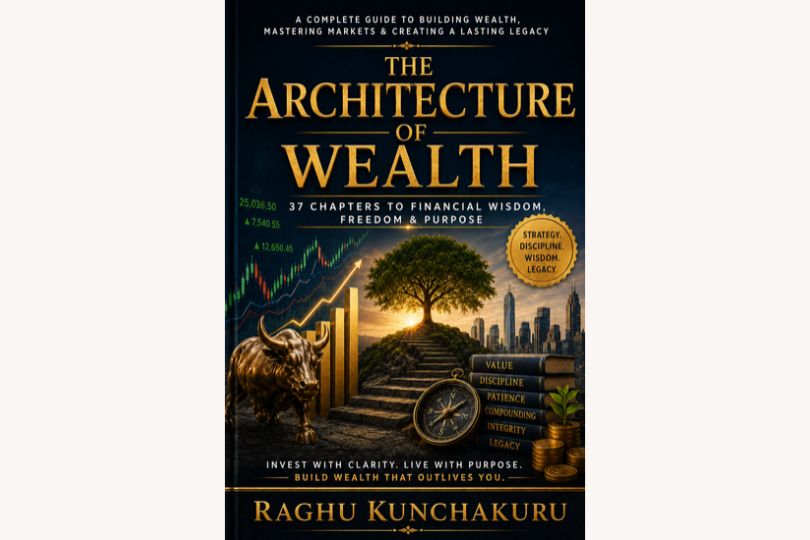
The Architecture of Wealth by Raghu Kunchakuru: Building Financial Freedom Through Discipline, Behaviour and Long-Term Thinking
Introduction
Wealth creation is often associated with market opportunities, investment strategies and the ability to identify profitable assets. Yet, the foundation of lasting financial success may lie much deeper—in the way individuals think, make decisions and respond to uncertainty. The Architecture of Wealth by Raghu Kunchakuru explores this idea, presenting wealth not as an outcome of luck or speculation, but as something that must be carefully designed through rational decisions, disciplined investing and consistent learning.
The book opens with a compelling principle: “Before wealth compounds in your portfolio, it must first compound within you.” This thought establishes its central argument: successful investing depends as much on investor behaviour as it does on financial knowledge. Rather than promising shortcuts or extraordinary returns, Kunchakuru offers readers a structured approach to understanding money, evaluating businesses and building wealth over time.
Book Summary
Structured across 37 chapters and eight parts, The Architecture of Wealth presents a comprehensive framework for approaching personal finance and investing. It begins with the fundamentals of compounding and investor psychology, establishing why patience, discipline and emotional awareness are essential to long-term financial growth.
From there, the book moves towards understanding businesses and the principles behind sound investment decisions. It examines how investors can assess businesses, evaluate their value and make decisions with an appropriate margin of safety. These concepts are accompanied by discussions of risk, diversification and asset allocation, helping readers understand how individual investment choices contribute to a broader financial strategy.
The book also explores the lessons that emerge from market bubbles and crashes. These episodes demonstrate how speculation, excessive optimism and emotional decision-making can undermine even seemingly promising investments. By examining such patterns, Kunchakuru encourages readers to develop a more measured perspective towards market movements.
Drawing on the ideas of influential investors and thinkers such as Benjamin Graham, Warren Buffett, Charlie Munger, Peter Lynch and Howard Marks, the book brings established investment wisdom into a practical framework. Case studies, investor insights and checklists help connect these principles with real-world decision-making.
Ultimately, the book presents wealth creation as a gradual process built on sound judgement, informed ownership and consistency rather than short-term market predictions.
What Makes The Architecture of Wealth Different?
One of the book's defining strengths is its emphasis on the investor rather than the market. While many discussions of investing focus on identifying opportunities, analysing stocks or predicting market movements, Kunchakuru places considerable importance on the mindset behind financial decisions.
The distinction between ownership and speculation is central to this approach. The book encourages readers to understand the businesses they invest in instead of treating financial assets merely as instruments for quick gains. It also places patience above prediction, suggesting that long-term results are more likely to emerge from disciplined decisions than from attempts to anticipate every market movement.
Another important aspect is the book's integrated structure. Instead of presenting investment concepts as isolated lessons, it connects psychology, business analysis, valuation, risk management and portfolio construction. This allows readers to understand how different elements work together within a larger wealth-building framework.
Its refusal to promise quick wealth also gives the book a grounded perspective. It focuses on principles that can remain relevant across different market conditions rather than strategies dependent on temporary trends.
Themes Explored in The Architecture of Wealth
1. The Power of Compounding
Compounding is one of the central ideas in the book. It demonstrates how wealth can grow when returns are reinvested and allowed to accumulate over extended periods. However, Kunchakuru's approach extends beyond financial calculations. He also highlights the importance of allowing knowledge, experience and sound habits to compound over time.
The book presents compounding as a process that rewards consistency and patience. It encourages readers to look beyond immediate gains and recognise the significance of sustained financial decisions.
2. Investor Psychology and Behaviour
Financial markets are influenced not only by business performance and economic conditions but also by human emotions. Fear, greed, impatience and overconfidence can shape investment decisions, often leading individuals away from rational judgement.
By examining investor psychology, the book highlights why emotional discipline is essential. It encourages readers to recognise behavioural tendencies and develop the ability to make decisions based on reasoning rather than temporary market sentiment.
3. Understanding Businesses and Valuation
A sound investment begins with understanding what one owns. The book explores the importance of reading businesses, evaluating their fundamentals and assessing whether their value justifies the price being paid.
Through its discussion of valuation and margin of safety, it introduces readers to the importance of avoiding investments based solely on popularity or market excitement. These principles encourage a more thoughtful approach to identifying opportunities and managing uncertainty.
4. Risk, Diversification and Asset Allocation
Investment decisions inevitably involve risk. The book examines how investors can approach uncertainty through diversification, appropriate asset allocation and a clear understanding of their financial objectives.
Rather than treating risk as something that can be eliminated, it encourages readers to recognise and manage it. This perspective is important for building portfolios that can withstand changing market conditions.
5. Learning from Market Bubbles and Crashes
Market bubbles and crashes reveal how collective behaviour can influence financial decisions. Periods of excessive optimism may encourage speculation, while sudden downturns can trigger fear and impulsive reactions.
By exploring lessons from these events, the book encourages readers to develop a long-term perspective. It suggests that understanding past market behaviour can help investors remain more composed when faced with uncertainty.
6. Wealth as a Foundation for Freedom
Beyond investment strategies, The Architecture of Wealth considers the larger purpose of financial planning. Wealth is presented as a means of creating freedom, security and the ability to make meaningful choices.
The book also looks towards the preservation and transfer of wealth across generations, extending its framework beyond individual financial growth. This gives its discussion a broader perspective on financial responsibility and legacy.
Writing Style and Reading Experience
The book's structured approach makes it relevant to readers with different levels of investment experience. Its progression from foundational concepts to business evaluation, risk management and portfolio construction provides a logical learning path.
The inclusion of case studies, insights from established investors and practical checklists helps connect theoretical principles with investment decisions. Readers are encouraged not simply to understand financial terminology but to consider how these ideas can influence their own approach to money.
By drawing on the work of respected investment thinkers, Kunchakuru places his framework within a wider tradition of value investing and long-term financial thinking. The result is a book that prioritises clarity, practical application and enduring principles over market speculation.
About the Author
Raghu Kunchakuru is a Senior Finance Professional and a passionate student of investing, business, economics and human behaviour. His work is guided by the belief that financial freedom can be achieved through rational decision-making, disciplined investing, continuous learning and the power of long-term compounding.
Inspired by some of the world's most respected investors and thinkers, Kunchakuru seeks to simplify complex financial concepts into practical frameworks that investors can apply at different stages of their financial journey.
His philosophy places ownership above speculation, patience above prediction and behaviour above brilliance. Through The Architecture of Wealth, he aims to offer readers a lasting blueprint for building, preserving and transferring wealth across generations.
Who Should Read The Architecture of Wealth?
The Architecture of Wealth is suited to both beginners who want to establish a sound foundation in investing and experienced investors looking to refine their financial decision-making.
Readers interested in value investing, business analysis, investor psychology and long-term wealth creation will find its themes particularly relevant. It may also appeal to individuals who want to understand the relationship between financial discipline and personal freedom.
Rather than offering a formula for quick returns, the book is intended for those willing to learn, exercise patience and follow a consistent investment philosophy.
Conclusion
The Architecture of Wealth by Raghu Kunchakuru presents wealth creation as a deliberate and continuous process shaped by knowledge, behaviour and disciplined decision-making. Its central message is that financial success cannot be separated from the mindset and habits developed along the way.
By bringing together compounding, investor psychology, business evaluation, valuation and risk management, the book offers a connected framework for approaching long-term investing. Its emphasis on ownership, patience and rational thinking makes it a useful contribution to conversations about financial literacy and responsible wealth creation.
Ultimately, the book reminds readers that building wealth is not simply about accumulating money. It is about developing the judgement and discipline required to create financial security, preserve opportunities and build a meaningful legacy.
Post a comment
0 comments

Trending Posts










Recent Post







Related Post








© 2026 - Frontlist - News and Updates of Publishing Industry, Book Reviews, Education News, Author Interviews, and Videos.. All Rights Reserved.
Sorry! No comment found for this post.