INTERVIEW WITH DR. SHUBHA VILAS, AUTHOR OF LIVE, LEAD, LOVE
In this author interview, Shubha Vilas explores how the Mahabharata, Ramayana and Bhagavata offer timeless lessons on resilience, purposeful leadership and love.on Oct 22, 2026
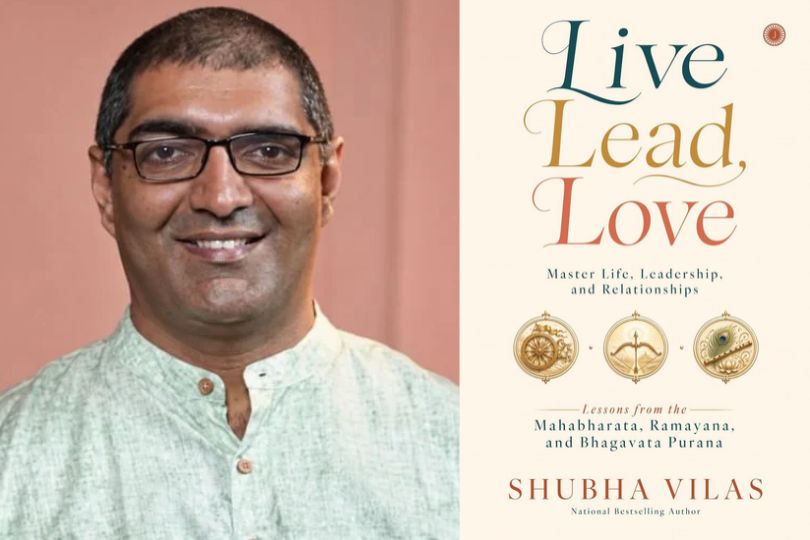
Frontlist: You have a background in Electronics Engineering and Law, yet you've built your career around spirituality and leadership. What drew you to make that shift?
Shubha: People assume it was a U-turn. To me, it felt more like following a question back to its origin. Engineering trained me to ask where a system fails. Not whether it will fail, but where. Every machine has a failure mode, and so, I discovered, does every human being: fear, ego, grief, envy.
Law taught me something more unsettling. A principle applied without understanding can do more damage than having no principle at all. There's a moment in the Mahabharata where Arjuna raises his sword over his own elder brother to honour a private vow, and Krishna calls him a fool: a man who clings to the letter of truth without grasping its spirit. Any lawyer who has watched a technically correct judgment destroy a family knows exactly what Krishna meant.
Then came my years as a monk. The questions people carried into the room were never about circuits or statutes. How do I go on after this loss? How do I lead people who've stopped trusting me? Why does my marriage feel like two people managing a household? My degrees had given me precision but no vocabulary for the heart. The epics had both. So I didn't move from logic to faith. I moved from solving problems to understanding the people who have them.
Frontlist: Your PhD focused on Leadership Effectiveness through the lens of the Valmiki Ramayana. What made you choose an ancient epic as the foundation for a leadership thesis?
Shubha: Because most leadership research studies results, and the Ramayana studies the price of results.
In the book, I point out that Ravana was a superb manager. Lanka was rich, efficient, magnificently run. On most dashboards he would rank as a high performer. Yet the epic insists he was not a leader. My thesis lived in the gap between those two words.
Look at Bharata. He is handed a throne he never asked for. He accepts the responsibility and refuses every privilege. He takes no palace and no comforts. For fourteen years he lives in a hermitage outside Ayodhya and sleeps on the bare ground. When he returns the kingdom to Rama, it is nine times more prosperous. No KPI in the world predicts that. Or think of Rama and Sita on the eve of their coronation. They sit on kusa grass beside a sacred fire, and they don't celebrate the power coming to them. They pray for the strength to carry it.
A business-school case study covers a few quarters, perhaps a decade. The Ramayana has been read, tested and argued over by every kind of person in every century, and it still holds. For a researcher, that isn't mythology. It's the longest-running longitudinal study of character under pressure that we have.
Frontlist: Live, Lead, Love draws on the Mahābhārata, Rāmāyaṇa, and Bhāgavata. What made you choose these three texts specifically, and how do they complement one another in the book?
Shubha: Each epic has its own temperament, and I let that temperament choose its section.
The Mahabharata is the most honest of the three about how messy life is. Almost no one in it is simply good. Bhishma was capable of extraordinary sensitivity toward his father, yet he was blind to Amba's heartbreak, and that blindness followed him to his death. It is the epic of the forest: uncertainty, grey choices, grief. So it teaches us how to live.
The Ramayana offers what the Mahabharata deliberately withholds, which is an ideal. Leadership needs a North Star. Rama Rajya is really the story of a culture being built, one character at a time. So it teaches us how to lead.
The Bhagavata is where the camera moves closest to the heart. Uddhava and Vidura, two men worn down by loss, meet after a catastrophe and simply sit in silence before either of them speaks. That is the Bhagavata's register: intimacy. So it teaches us how to love.
What fascinates me is the thread that runs through them. The Krishna who physically tackles Bhima to the ground when the Narayanastra rains down, because surrender is the only defence, is the same Krishna who plays wrestling games with cowherd boys in Vrindavan. You need realism, idealism and intimacy together. A life built on only one of them tilts.
Frontlist: The book is structured around three themes: resilience, purpose, and love. Why did you choose this particular sequence, and do you see one as a foundation for the others?
Shubha: The book opens with the idea that all three needs come from a single longing: to leave something meaningful behind. How we live, lead and love is how we write our legacy. The order follows that logic.
Resilience comes first because you cannot give from a collapsed centre. The Mahabharata shows this through two mothers. Gandhari lived to prove; Kunti lived to improve. Gandhari's son grew up invincible in body and hollow inside, and a hollow person doesn't lead. He competes. Kunti raised her sons in a forest with no shortcuts, and they could lose everything and still turn a wilderness into Indraprastha.
Purpose comes second because leadership is where resilience stops being private. Strength that serves only you is just endurance. And love comes last because it is the reason for the other two.
There's also a quieter arc that readers may only notice on a second reading. The Live section ends with "Find Yourself a Dhaumya": you need a guide. Lead ends with Hanuman becoming a torchbearer for someone who has lost hope: now you are the guide. Love ends with Krishna and Sudama, two people who need nothing from each other except each other. First you are held, then you hold others, and finally you learn simply to be with someone. That, to me, is the shape of a mature life.
Frontlist: Having delivered over 6,000 talks across twenty countries, including at companies like Google, Microsoft, and Samsung, how do you adapt timeless scriptural stories for modern corporate audiences?
Shubha: I strip away the jargon but keep the soul. Many rooms don't need the Sanskrit. Every room needs the story.
Stories work where advice fails for a simple reason. The ego defends itself against instruction, but it lowers its guard for a narrative. You can watch someone else's mistake without flinching and only later realise it was yours.
Here's one I tell often. After Sita is abducted, Rama is half-mad with grief. He comes across a huge, bloodied bird and concludes it must have devoured her, so he raises his bow. Then from that broken beak comes a single word: Ayushmaan, may you live long. It is Jatayu, who had fought Ravana to save Sita. Rama nearly killed his most loyal ally because he was listening to his assumptions instead of to the being in front of him.
Then I ask a room of senior executives why so many people confide more easily in Siri and Alexa than in their managers. It isn't the answers. The machine never interrupts, never finishes your sentence, never rehearses its reply while you're still talking. There is usually a long, uncomfortable silence, because every leader in that room has raised the bow at least once that week. After six thousand talks, I've learned that Seoul and Bangalore are moved by exactly the same thing. They just need different doors into it.
Frontlist: Your Ramayana: The Game of Life series spans six volumes. How did that project shape the way you approached writing Live, Lead, Love?
Shubha: Six volumes on one epic taught me to read slowly. Slow reading teaches you that the epics hide their most important lessons in the margins.
Most retellings rush past the moment when Balaram, the strongest of all the boys, cries out in fear as a demon carries him away. The text is careful to say he hadn't lost his strength. He had forgotten it. Krishna doesn't chase after them. He speaks fifteen lines reminding his brother who he is, and Balaram remembers. That one detail became an entire chapter on cheering people forward.
Or take Vali, dying, questioning the very man who shot him, while Rama answers patiently. It may be the only conversation in literature where the killer explains himself and the victim listens.
The series gave me an eye for the hinge, the small detail on which a whole story turns. What it couldn't give me was the harder skill this book demanded: holding three epics inside one argument. When you stay within one text, its internal logic carries you. When you move across three, you need a spine of your own. Live, Lead, Love was the book where I had to build that spine.
Frontlist: For readers unfamiliar with these three epics, what's one story or episode from the book that you feel captures its central message?
Shubha: Krishna and Sudama. I'd ask readers to notice the details, because the message lives in them.
Sudama is so poor that his children are going hungry. His wife borrows a few handfuls of flat rice from four different neighbours so he won't arrive empty-handed. He walks barefoot to Dwaraka, wondering whether the king will even remember him. At the gates, nobody stops him. Krishna had long ago instructed that no brahmana was ever to be turned away. The welcome was decided before the guest arrived, and that is leadership in one line: culture is set before the moment, not during it.
Krishna is sitting with Rukmini when he suddenly leaps up and runs across his palace. He seats Sudama on his own bed and washes his feet with his own hands. He snatches the little bundle of rice and eats it with a child's delight, until Rukmini stops his hand because she wants some too.
The part I love most is this: Sudama never asks for anything, and Krishna never mentions giving anything. Sudama goes home to find his hut transformed. The most powerful gifts are given in silence.
The central message is that the true measure of a person is how they treat someone who can give them nothing in return. Everything else in the book is commentary on that.
Frontlist: "Leading with purpose" is one of the book's core sections. How do you distinguish purpose-driven leadership from more conventional models of leadership?
Shubha: Conventional leadership asks, "What did you get people to do?" Purpose-driven leadership asks, "Who did people become around you?"
The book's clearest picture of this is Hanuman with Sugriva. Sugriva is a king in exile, so traumatised by his brother's betrayal that he sees every stranger as an assassin. Hanuman doesn't lecture him out of his fear. He reframes what Sugriva is looking at: these are allies, not enemies. He shows him a possibility he had missed, sets one clear goal, stands beside him and keeps more than one path open. Then he practises something rarely taught, which is strategic patience. Sugriva had to rise in his own eyes before anyone else would follow him. Hanuman didn't rescue a victim. He revived a king.
The second idea is more provocative. Rama's allies were not calm people. Lakshmana burned with indignation, Sugriva with humiliation, Vibhishana with grief. A modern hiring filter might have rejected all three. Rama saw that their anger came from conscience rather than ego, and he gave it a direction. The word passion comes from the Latin pati, to suffer. Your purpose is whatever you are willing to suffer for.
So a purpose-driven leader does two things a manager rarely does. They restore people's belief in themselves, and they turn people's pain into a cause.
Frontlist: The book's third theme is "loving with consistency." What does consistency in love mean in the context of these ancient narratives, and how is it relevant to modern relationships?
Shubha: Everyone remembers how Krishna and Rukmini began: the secret letter, the ride through the night to Vidarbha, the chariot tearing through the crowd. The moment I find most revealing is quieter. As they race away with Shishupala in pursuit, Krishna speaks his very first words to her: don't worry, your soldiers will take care of this. Before a single wedding ritual, he has made her a queen, and he did it with a pronoun.
Consistency means that pronoun never changes. The text tells us Krishna never stopped making her feel precious across their whole life together. He did it through a steady flow of small acts more than through grand gestures.
Look at what that steadiness makes possible. Decades later, as grandparents, Krishna teases her that she chose badly and could still leave him for a better match. For one terrible moment she believes him, and the fan slips from her hand. Then she catches the twinkle in his eyes and answers him point for point. Only a deeply secure love can joke about ending.
Consistency is only half the book's answer, though. The very next chapter is about newness. Brahma, the creator of the universe, is humbled because he assumed he fully understood a seven-year-old cowherd. We stop seeing people the moment we think we've figured them out. So the secret is a paradox: be utterly predictable in your care, and endlessly curious about the person receiving it. Modern relationships often get this backwards. They are unpredictable in affection and incurious about each other.
Frontlist: With more than 40 books published, how do you keep finding fresh angles within these same source texts, and what's different about the lens you brought to this particular book?
Shubha: The honest answer is that I stopped asking the texts questions one at a time and started asking them together. When you do that, patterns appear that no single epic reveals.
Here's one I never noticed until this book: charioteers. In the Mahabharata, Krishna chooses to serve as Arjuna's charioteer. On the night before Jayadratha's death, it is to his own charioteer, Daruka, that he confesses he loves no one as much as Arjuna. In the Ramayana, Rama catches himself giving Matali an order in a commanding tone, stops, and apologises. Ravana is carried unconscious off the battlefield by his charioteer, and when he wakes he smashes the man's water vessel in rage. In the Bhagavata, it is Daruka again who drives Krishna through the night to reach Rukmini.
Three texts carry one silent question: how do you treat the person who drives your chariot, the one who carries you and is rarely thanked? That answer separates Rama from Ravana more precisely than any battle does.
That's the lens this book brought. It goes across three texts instead of deeper into one, and it is organised by the part of life a story speaks to rather than the text it comes from. More than forty books in, the epics haven't run out of answers. I've simply learned to put better questions to them, and to put those questions to all three at once.
Post a comment
0 comments

Trending Posts







Recent Post




Related Post
 (1).jpg)


© 2026 - Frontlist - News and Updates of Publishing Industry, Book Reviews, Education News, Author Interviews, and Videos.. All Rights Reserved.
Sorry! No comment found for this post.