Interview: Arun Mathews, Author of The Emotionally Intelligent Husband
In this author interview, Arun discusses The Emotionally Intelligent Husband, exploring emotional awareness, communication, Indian marital culture and practical ways to build healthier relationships.on Oct 30, 2026
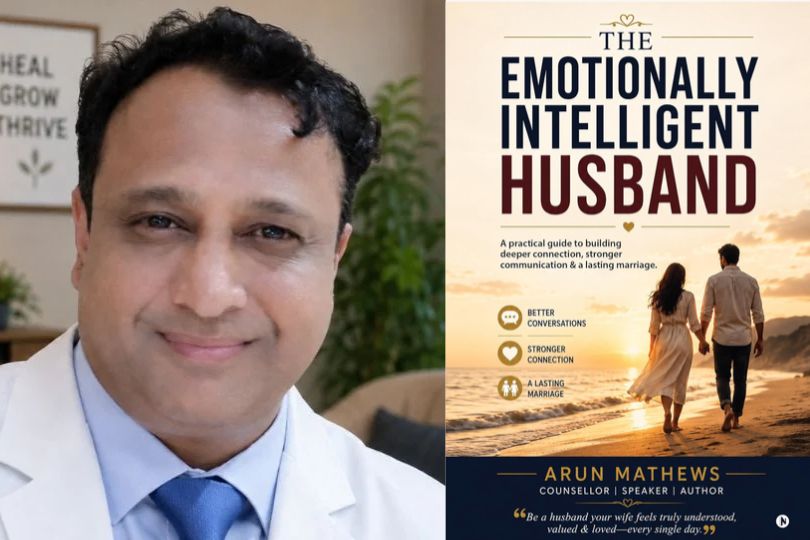
Frontlist: What inspired you to write The Emotionally Intelligent Husband, and was there a specific moment or relationship that sparked the idea?
Arun: The idea came from years of working with individuals and couples and observing a pattern that kept appearing in different forms. Many men genuinely love their wives and families, but they often don't know what to do with emotions — their own or their partner's.
I noticed that a husband could be excellent at solving problems at work, managing finances, fixing things around the house and planning the next family holiday, but when his wife said, "I just want you to understand how I feel," suddenly there was no operating manual!
That observation stayed with me.
I wanted to write a book that spoke directly to husbands without lecturing them. Marriage isn't about winning an argument; it is about understanding the person sitting across the table from you. And sometimes, the most emotionally intelligent response to your wife's problem is not to offer a solution within 30 seconds!
So the book grew out of my work as a psychologist and relationship therapist, my observations of relationships, and my belief that emotional intelligence is one of the most important — and least discussed — skills in marriage.
Frontlist: How do you define "emotional intelligence" specifically in the context of marriage, as opposed to the workplace or general life?
Arun: In the workplace, emotional intelligence can mean knowing when to speak, when to listen, how to manage conflict and how not to send an angry email to your boss at 11:30 at night!
In marriage, it is much more personal.
For me, emotional intelligence in marriage means being able to recognise what you are feeling, understand why you are feeling it, regulate your reactions, and still remain emotionally available to your partner.
It is also about being curious about your spouse's emotional world.
You don't necessarily have to agree with your partner's feelings. But you need to be able to say, "I can understand why you felt that way."
That one sentence can sometimes do more for a marriage than a 45-minute argument.
Ultimately, emotional intelligence in marriage is about moving from "How do I prove I'm right?" to "How do we understand each other?"
Frontlist: Many books on marriage focus on the wife's emotional needs. What made you want to centre the conversation on husbands?
Arun: I certainly don't believe that men's emotional needs are more important than women's. Quite the opposite — I think both matter equally.
But I noticed that men are sometimes given surprisingly little guidance on the emotional side of marriage.
We teach boys how to compete, achieve, earn, provide and be independent. But we don't always teach them how to say, "I'm hurt," "I'm scared," "I don't know what to do," or even "I'm sorry."
And let's be honest — "I'm sorry" is sometimes treated by men as though it is a limited-edition luxury item!
I wanted to change that conversation.
The book is written for husbands, but ultimately it is about creating healthier marriages. When one partner becomes more emotionally aware, it can influence the entire relationship.
So I am not saying, "Husbands, everything is your fault."
I am saying, "Husbands, you have more influence on the emotional climate of your marriage than you may realise."
And that is actually an empowering message.
Frontlist: In your research or personal experience, what's the most common emotional blind spot you see in husbands today?
Arun: One of the biggest blind spots is confusing problem-solving with emotional connection.
A wife may say, "I'm feeling overwhelmed," and the husband's brain immediately goes into engineering mode:
"Okay. Let's identify the problem. What is the solution?"
But sometimes she isn't asking for a solution. She's asking to be heard.
Another common blind spot is emotional avoidance. Some men have learned that showing vulnerability means showing weakness. So they suppress anger, sadness, fear or disappointment until those emotions eventually come out as irritation, withdrawal or silence.
And there is another interesting one: many men don't realise how much their silence communicates.
A husband may think, "I'm not saying anything, so I'm not making the situation worse."
His wife may be thinking, "He doesn't care."
Same silence. Two completely different interpretations.
That's why emotional awareness is so important.
Frontlist: Do you think emotional intelligence in husbands is something that can be taught later in life, or does it need to be nurtured from a young age?
Arun: Absolutely, it can be learned later in life.
If emotional intelligence could only be developed during childhood, I'd have to close my counselling practice and start selling bicycles!
We are capable of learning new emotional habits throughout our lives.
Of course, childhood experiences influence how we communicate, handle conflict and express emotions. But those patterns are not permanent.
A man who grew up hearing "Boys don't cry" can learn as an adult that vulnerability isn't weakness.
A husband who has spent 20 years avoiding difficult conversations can learn to have them differently.
The brain is remarkably adaptable. With awareness, practice and sometimes professional guidance, people can develop much healthier emotional responses.
The important thing is not to ask, "Why am I like this?"
Ask, "What can I do differently from today?"
Frontlist: How does culture, particularly Indian family and marital culture, shape how men express or suppress emotions with their spouses?
Arun: Indian culture has many wonderful strengths — family connection, loyalty, responsibility and a strong sense of duty.
But there can also be a traditional definition of masculinity that tells men that they must always be strong, provide for the family and keep their emotions under control.
The problem is that emotions don't disappear just because we don't talk about them.
They usually find another exit!
In many Indian families, boys may grow up seeing fathers who rarely express affection verbally or discuss emotional struggles. The son then unconsciously learns, "This is what being a man looks like."
At the same time, Indian marriages are changing. Couples today are often looking for friendship, emotional intimacy, companionship and equality in addition to the traditional roles of husband and wife.
So men are navigating a changing landscape.
I don't think we need to throw away everything from the past. We simply need to add something that was sometimes missing: emotional openness.
Being responsible for your family and being emotionally vulnerable are not opposites. In fact, I think the strongest husbands are capable of both.
Frontlist: Can you share one practical habit or exercise from the book that husbands can start using immediately to become more emotionally attuned?
Arun: One simple practice I recommend is what I call "Listen Before You Fix."
When your wife shares something emotional, resist the immediate temptation to solve the problem.
Instead, do three things:
Listen. Reflect. Validate.
For example, instead of saying:
"Why don't you just ignore her?"
try:
"That sounds like it really upset you. I can understand why you felt hurt."
You don't have to agree with everything. You are simply acknowledging the emotion.
I would also encourage couples to have a short daily emotional check-in — even 10 minutes without phones, television or children interrupting every 37 seconds.
Ask:
"How are you feeling today, really?"
And then listen.
It sounds simple, but consistency is more important than complexity when it comes to relationships.
Frontlist: How did you balance offering guidance to men without making the book feel preachy or like it's placing blame?
Arun: That was very important to me.
I didn't want to write a book that essentially said, "Dear Husband, here are 247 things you are doing wrong."
Nobody would finish Chapter One!
I wanted husbands to feel understood, not attacked.
I also recognise that men are not the only people who can struggle emotionally in relationships. Every partner brings their own history, expectations, wounds and communication patterns into a marriage.
So the message of the book isn't about blaming men. It is about giving men responsibility without shame.
There is a big difference between saying:
"You are the problem."
and saying:
"You have the ability to become part of the solution."
I chose the second approach.
My hope is that a husband reading the book will occasionally recognise himself and think, "Hmm... I've actually done that."
And then, rather than feeling defensive, he'll think:
"Maybe I can do this differently."
That is where change begins.
Frontlist: What has the response been like from female readers versus male readers?
Arun: The response has been interesting because men and women often seem to approach the book from slightly different perspectives.
Women tend to recognise many of the emotional situations immediately. I often hear the sentiment, "I wish my husband would read this."
Men, on the other hand, can initially approach the book with a little more caution — sometimes with the emotional equivalent of checking whether there is a trap hidden inside the pages!
But once they engage with the material, I think many men recognise that the book isn't about telling them how to become someone else. It's about helping them understand themselves and their relationships better.
And I particularly like it when a husband says, in effect, "I never thought about it that way before."
That is the response I am looking for.
Because the purpose of the book isn't to create perfect husbands.
There is no such thing. And if anyone claims to be one, I would like to meet his wife before believing him!
The goal is to create husbands who are more aware, more responsive and more willing to grow.
Frontlist: If a reader takes away just one idea from this book, what do you hope it is?
Arun: I would want them to understand that emotional intelligence is not about becoming less of a man. It is about becoming a better partner.
You don't have to have all the answers.
You don't have to win every disagreement.
You don't even have to understand every emotion immediately.
But you can learn to listen better, communicate more honestly, regulate your reactions and make your partner feel emotionally safe.
A marriage isn't built only through the big romantic moments. It is built through hundreds of small interactions — how we respond when our partner is upset, how we handle disagreement, whether we listen, whether we apologise, whether we show appreciation and whether we continue choosing each other even on difficult days.
If someone finishes my book and thinks,
"I understand my wife a little better, I understand myself a little better, and I know one thing I can do differently tomorrow,"
then I feel the book has done its job.
Because emotional intelligence isn't about having a perfect marriage.
It's about having the awareness and courage to keep making the marriage better.
Post a comment
0 comments

Trending Posts






Recent Post




Related Post

 (1).jpg)


© 2026 - Frontlist - News and Updates of Publishing Industry, Book Reviews, Education News, Author Interviews, and Videos.. All Rights Reserved.
Sorry! No comment found for this post.