Great Bharata: The Invasion Begins | A New Retelling of the Mahabharata
A retelling of the Mahabharata through Satyavati’s journey, exploring power, destiny, cosmic forces and the spiritual dimensions of the epic.on Oct 01, 2026
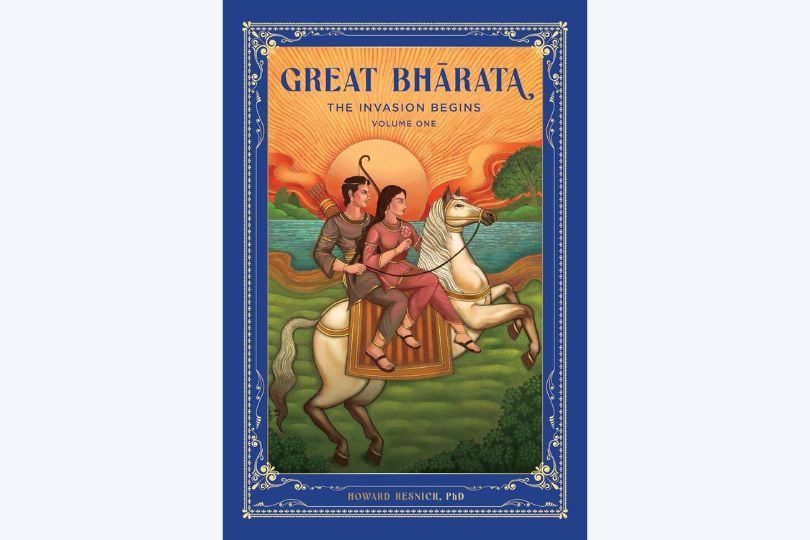
Great Bharata the Invasion Begins: A New Retelling of the Mahabharata’s Epic World
Great Bharata the Invasion Begins by Dr. Howard Resnick, also known as H. D. Goswami, offers a sweeping retelling of the Mahabharata that brings one of India's greatest epics into a vivid narrative framework. The first volume of a multi-volume saga, the book places Satyavati at the centre of its opening story, tracing her extraordinary journey from a humble fishing village to the heart of political and worldly power.
Drawing on his scholarship in Sanskrit and Indian Studies, Dr. Resnick approaches the epic through more than its familiar succession of kingdoms, dynasties and conflicts. The narrative brings together the earthly, cosmic and spiritual dimensions of the Mahabharata, creating a retelling that looks at the epic as both a grand human story and a work shaped by deeper philosophical and spiritual ideas.
Book Summary
At the centre of Great Bharata the Invasion Begins is Satyavati, whose journey provides the narrative foundation for this first volume.
Beginning in a humble fishing village, Satyavati's life gradually moves towards the centre of a world shaped by power, destiny and extraordinary events. Her rise places her in circumstances far removed from her origins and gives her a pivotal role in the larger story of the Mahabharata.
Through her journey, the book explores the movement from an intimate, human beginning towards a much larger world of kingdoms, cosmic forces and spiritual significance.
As the opening volume of a multi-volume saga, the book establishes a narrative landscape in which individual lives and immense historical and mythological forces intersect. The story is therefore not confined to one dimension. It moves between the personal and political, the earthly and cosmic, and the human and spiritual.
The result is a retelling that seeks to bring the scale and complexity of the Mahabharata to contemporary readers while retaining its connection to the epic's deeper traditions.
What Makes Great Bharata the Invasion Begins Different?
One of the defining features of Great Bharata the Invasion Begins is its decision to foreground Satyavati.
The Mahabharata contains an enormous cast of characters whose lives are intertwined through family, political power, relationships, duty and destiny. By placing Satyavati's journey at the heart of the first volume, Dr. Resnick provides readers with a distinctive entry point into this vast narrative universe.
Her movement from a fishing village to the centre of world power also creates a strong contrast between beginnings and destiny. Her story demonstrates how an individual's circumstances can change dramatically as larger forces begin to shape their life.
The book's other distinctive feature is its attempt to hold together multiple dimensions of the epic. The Mahabharata is not presented merely as a historical or political tale, nor solely as a spiritual text. Instead, the narrative brings together earthly events, cosmic dimensions and spiritual meaning.
Themes in Great Bharata the Invasion Begins
Satyavati and the Journey from Humble Beginnings
Satyavati's transformation is one of the central narrative threads of the book.
Her journey from a fishing village to a position at the centre of power creates a story of profound social and personal transformation. It raises questions about identity, destiny and the circumstances through which an individual becomes part of a much larger historical and cultural story.
Power and Destiny
As Satyavati enters the world of power, the personal becomes connected to political and dynastic forces.
The book uses this movement to establish one of the recurring concerns of epic literature: the relationship between individual choices and forces that appear larger than any one person.
Power is therefore not simply political. It is connected with family, duty, destiny and the unfolding of a much greater story.
The Human and the Cosmic
The Mahabharata has always occupied a space between the recognisably human and the extraordinary.
Great Bharata the Invasion Begins retains this characteristic by weaving earthly events with cosmic dimensions. Characters experience ambition, relationships and struggles, while their stories simultaneously participate in a much larger universe of meaning.
This combination allows the narrative to operate on different levels, inviting readers to experience the epic both as a compelling story and as part of India's philosophical and spiritual heritage.
The Spiritual Dimension of the Epic
The spiritual dimension is another important aspect of the book.
Rather than separating narrative action from spiritual significance, the book brings the two together. The world of the Mahabharata becomes a space in which human decisions and worldly events can also carry deeper implications.
This approach reflects the richness of the epic tradition, where stories of kingdoms and families coexist with questions concerning dharma, destiny and the nature of existence.
The Beginning of a Larger Saga
As the first volume of a multi-volume work, Great Bharata the Invasion Begins also has the task of establishing the foundation for what follows.
The story introduces characters, relationships and circumstances that will contribute to a much larger narrative. The emphasis on beginnings is therefore significant: readers are witnessing the formation of a world whose consequences extend far beyond the immediate events of the opening volume.
Retelling the Mahabharata for Contemporary Readers
Retelling an epic as expansive as the Mahabharata requires navigating between familiarity and reinterpretation.
Readers may already know many of the epic's characters and broad narrative traditions, but a retelling can shift attention towards characters, relationships and dimensions that deserve renewed consideration.
Dr. Resnick's academic background in Sanskrit and Indian Studies provides an important foundation for his engagement with this material. His work reflects an effort to connect the depth of Indian philosophical traditions with a form of storytelling that can reach contemporary readers.
In Great Bharata the Invasion Begins, this is particularly visible in the way the personal journey of Satyavati becomes the doorway into a much larger epic universe.
Writing Style
The book combines the scale of epic storytelling with a strong focus on character and narrative movement.
Its premise gives the opening volume a clear human centre in Satyavati, while the broader story expands into political, cosmic and spiritual dimensions. This allows the narrative to move beyond a simple retelling of events and towards a larger exploration of the world in which those events take place.
The combination of storytelling, Indian epic tradition and spiritual depth makes the book relevant to readers interested not only in the Mahabharata as a story, but also in the philosophical world surrounding it.
About the Author
Dr. Howard Resnick, also known as H. D. Goswami, is a teacher of the bhakti-yoga tradition and a scholar specialising in Sanskrit and Indian Studies.
He holds a PhD in Sanskrit and Indian Studies from Harvard University and has lectured at leading universities around the world. His academic work has engaged with Indian philosophy, Sanskrit and the traditions of bhakti yoga.
His scholarly articles have appeared through publications associated with Harvard, Columbia and University of California Presses.
Dr. Resnick is also developing HDG Global Publications, an initiative focused on making the wisdom of the Bhagavad Gita more accessible in Western countries. His broader work reflects an ongoing effort to communicate India's philosophical and spiritual traditions to contemporary audiences.
Who Should Read Great Bharata the Invasion Begins?
This book may particularly appeal to:
- Readers interested in the Mahabharata and Indian epics
- Those looking for contemporary retellings of classical Indian literature
- Readers interested in Satyavati and the early dynastic world surrounding the epic
- Students and enthusiasts of Sanskrit and Indian Studies
- Readers exploring Indian philosophy and spirituality
- Those interested in bhakti traditions and India's spiritual heritage
- Readers who enjoy large-scale historical, mythological and epic narratives
- Anyone interested in the intersection of human stories and cosmic themes
It can also serve as an entry point for readers who want to approach the Mahabharata through a character-centred narrative while remaining attentive to the epic's wider philosophical dimensions.
Conclusion
Great Bharata the Invasion Begins opens a new retelling of the Mahabharata by placing Satyavati at the centre of its first volume. Her journey from a fishing village to the centre of world power provides the human foundation for a much larger narrative involving destiny, power, cosmic forces and spiritual meaning.
The book's combination of earthly, cosmic and spiritual dimensions reflects the extraordinary range of the Mahabharata itself. At the same time, Dr. Howard Resnick's background in Sanskrit and Indian Studies brings scholarly engagement with Indian traditions to a narrative designed for contemporary readers.
As the beginning of a multi-volume saga, Great Bharata the Invasion Begins establishes the characters, world and ideas that will shape the larger story. For readers drawn to Indian epics, mythology, spirituality and literary retellings, it offers an opportunity to encounter the vast world of the Mahabharata through a distinctive narrative lens.
Post a comment
0 comments

Trending Posts
.jpg)
.jpg)


.jpeg)


.jpg)

Recent Post



Related Post






© 2026 - Frontlist - News and Updates of Publishing Industry, Book Reviews, Education News, Author Interviews, and Videos.. All Rights Reserved.
Sorry! No comment found for this post.